Silver Knowledge · 7 min read · July 2026
What Does EPBM Mean on Silver? EPBM Silver Marks Explained
Last updated
The Quick Answer
EPBM stands for Electroplated Britannia Metal — a pewter-like tin alloy (~93% tin) with a thin coating of real silver applied by electroplating. It is silver plate, not sterling silver, and carries no assay hallmarks. Most EPBM pieces are hollowware (teapots, coffee pots, cream jugs) made in Sheffield between roughly 1850 and 1930. Individual pieces are typically worth £10–£50; complete tea services in good condition from named makers can reach £100–£300.
Turn over an antique silver-looking teapot from a British household and there's a good chance you'll find four small letters stamped on the base: EPBM. It's one of the most common marks on Victorian and Edwardian hollowware, and it's also one of the most misunderstood. This is a plated piece, not solid silver — but that doesn't mean it's worthless, and it doesn't mean it's inferior work. Some of the most influential silver design of the late 19th century was executed in EPBM.
What does EPBM mean on silver?
EPBM means Electroplated Britannia Metal. The mark tells you the piece has a base metal core made of Britannia metal — a pewter-like tin alloy of roughly 93% tin, 5% antimony, and 2% copper — with a thin coating of pure silver deposited on top by electroplating. The silver layer is typically 5–30 microns thick, enough to give the piece the appearance and feel of solid silver while costing a fraction as much to produce.
Two things follow from that composition. First, EPBM is silver plate — not sterling. Sterling silver is 92.5% pure silver throughout; EPBM is base metal with a microscopic silver skin. Second, because Britannia metal is soft (it spins and casts beautifully but wears poorly under contact), EPBM was used almost exclusively for hollowware — teapots, coffee pots, cream jugs, sugar bowls, salvers, waiters — where the piece would sit on a table rather than take everyday knife-and-fork punishment. If you find flatware stamped EPBM, look twice; it's unusual enough to suggest either an experimental early piece or a misread stamp.
What is Britannia metal? (And why it’s not the same as Britannia silver)
Britannia metal is a specific pewter-family alloy developed in Sheffield in the 1770s by James Vickers. Its recipe is stable across manufacturers: approximately 93% tin, 5–7% antimony (for hardness), and 1–2% copper (for workability and colour). Compared to older lead-based pewters, Britannia metal is bright silver-white, harder, safer to eat off, and much easier to spin into hollow forms on a lathe.
Do not confuse Britannia metal with Britannia silver. They are entirely different materials with confusingly similar names:
- Britannia metal — a base metal alloy (mostly tin). No silver in the alloy itself. Used as the base for EPBM plate. Marked EPBM.
- Britannia silver — solid silver at 95.8% purity (higher than sterling’s 92.5%). A British assay standard. Marked with a seated Britannia figure and the numeral 958.
The naming collision is a genuine trap. Britannia silver was made mandatory in Britain from 1697 to 1720 to prevent silversmiths melting down coinage, and it’s still an optional higher standard today. Britannia metal was named later in tribute to the same figure but has no silver content and no assay history. If your piece is stamped EPBM you have plate; if it’s stamped 958 with a Britannia figure, you have solid silver at above-sterling purity. For the full explainer on how 925 sterling and 958 Britannia silver are marked, see our guide to what does 925 mean on silver.
How to identify EPBM on a piece (what the stamp actually looks like)
The EPBM stamp is punched into the underside of hollowware, usually alongside the maker’s trademark and a pattern number. The four letters appear together, either in one horizontal cartouche or in individual boxes side by side. Common variations:
- EPBM alone — the standard form
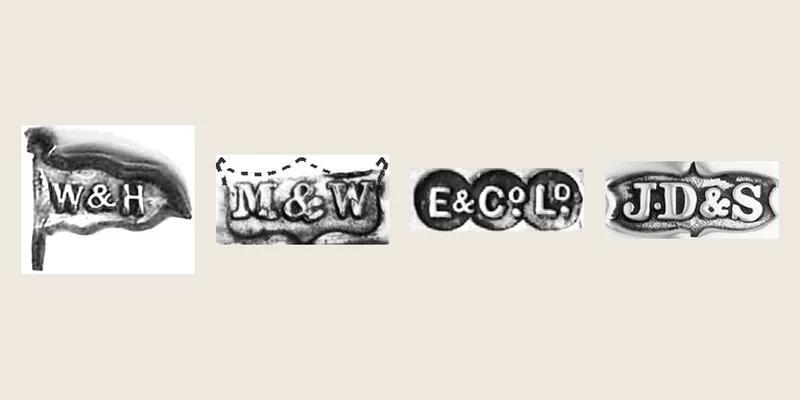
- EPBM + maker’s trademark — the most common configuration on Sheffield-made pieces. James Dixon & Sons used a bugle. Walker & Hall used a Pegasus. Elkington used their standard cypher.
- E.P.B.M. with periods — occasional variant, same meaning
- EPBM + pattern number — a 3–5 digit number identifying the specific design
What you will not find alongside an EPBM stamp is a British assay office hallmark. There is no lion passant, no leopard’s head, no date letter, no anchor. All of those marks are legally reserved for solid silver assayed by one of the four operating British assay offices — and applying them to plated silver has been illegal in Britain since the Sale of Goods Act 1893. If you see EPBM combined with something that looks like a hallmark, it’s a pseudo-hallmark: a decorative stamp the maker added to make the piece appear more official. Our guide to spotting fake silver covers pseudo-hallmarks in detail.
Found an EPBM stamp but not sure what maker it belongs to? Upload a photo to our silver hallmark identifier — Your first appraisal is free with a free account — no credit card. It reads maker trademarks alongside the plating mark.
Identify my EPBM mark →How to date EPBM silver plate
EPBM pieces don’t carry date letters, so dating relies on maker research and design cues. The technique itself narrows the window to roughly 1840–1930 — commercial electroplating was patented by Elkington in 1840, and by the 1930s the market had moved on to stainless steel and (from 1970s onwards) modern silver plate on nickel silver rather than Britannia metal. Within that window, three clues narrow the date further.
Maker mark. The two most prolific EPBM makers were James Dixon & Sons (Sheffield, working from 1806, EPBM production from ~1848) and Walker & Hall (Sheffield, established 1845). Look up the specific trademark in a maker’s reference like silvermakersmarks.co.uk to narrow to a specific decade. Elkington themselves made EPBM but preferred nickel silver bases for their higher-end lines.
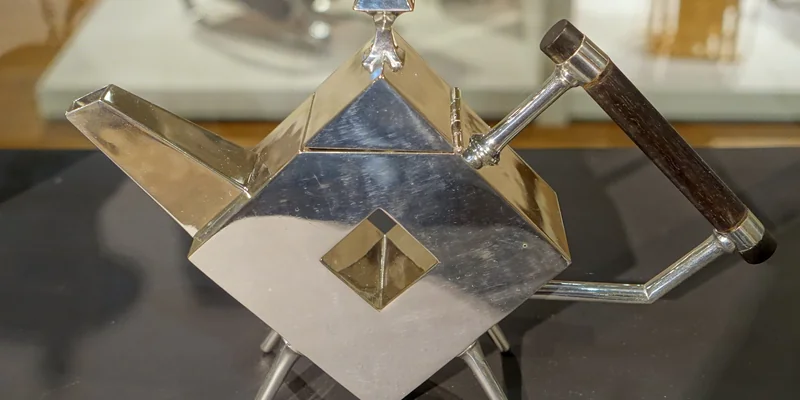
Design style. Early EPBM (1840s–1870s) follows classical Regency and early Victorian forms — simple ovoid teapots, minimal ornament. Mid-Victorian EPBM (1870s–1890s) is elaborately ornamented, often with naturalistic engraving and cast handles. Late Victorian and Edwardian EPBM (1890s–1910s) is often Aesthetic-movement or Christopher Dresser-influenced: angular geometry, ebony handles, sparse ornament. The Dresser teapot pictured at the top of this article is a landmark of the last group.
Pattern number. Some makers (Dixon in particular) used sequential pattern numbers throughout their production. If you can identify the maker and find a pattern-number reference for them, you can often date the piece to within a year or two.
Is EPBM silver worth anything?
Yes — but at a fraction of sterling silver’s value. EPBM has essentially no melt value because the silver layer is microscopically thin and the base metal is soft, non-precious tin alloy. Its market value comes from design, maker, condition, and completeness. Typical UK auction and secondary-market prices in 2026:
- Individual EPBM piece (a single teapot, cream jug, sugar bowl) — typically £10–£50. Higher end for named makers and unusual designs.
- Complete tea service (teapot + coffee pot + cream + sugar, matching pattern) from a respected maker like James Dixon & Sons or Walker & Hall — £100–£300 at auction.
- Christopher Dresser designs for Dixon & Sons or Elkington — a category of their own, frequently £300–£2,000+ depending on the specific pattern and condition. Museum-quality pieces have made five figures.
- Heavily worn EPBM where the tin base metal shows through at the high points — effectively near-zero collector value.
The value gap versus sterling is real: a comparable sterling silver teapot (~400 g of solid silver) has a floor value of roughly £240–£300 in metal alone before any maker premium. An EPBM teapot of identical size and form is worth £20–£80 unless the design or maker pushes it higher. For the full framework on setting a number on any silver piece, see our antique silver valuation guide.
EPBM vs EPNS: which is which?
Both marks denote silver plate — a real silver coating over a non-silver base — but they use different base metals. The choice of base metal shaped what kind of pieces the mark appears on and how the plating wears over time.
- EPBM — Electroplated Britannia Metal. Tin-based base metal (~93% tin). Soft, spins easily, appears almost exclusively on hollowware. When plating wears through, exposes a dull grey-white tin surface.
- EPNS — Electroplated Nickel Silver. Copper-nickel-zinc alloy base (contains zero actual silver despite the "nickel silver" name). Hard, takes fine detail, appears on both flatware AND hollowware. When plating wears through, exposes a yellowish or greenish copper-alloy surface.
EPNS is more common overall — it’s the standard mark on Victorian and Edwardian silver-plated flatware, and any set of “silver” cutlery from a UK grandparent’s canteen is overwhelmingly likely to be EPNS. EPBM is more specialised: if you own an antique silver-looking teapot or hollowware set, EPBM is a strong possibility, especially with a Dixon or Walker & Hall trademark. Both stay firmly in the silver-plate category. For the full breakdown of every plate mark and what it means, see our EPNS, EP, A1 and EPBM silver plate marks guide.
Frequently Asked Questions
What does EPBM mean on silver?
EPBM stands for Electroplated Britannia Metal. It means the piece has a base metal core made of Britannia metal — a pewter-like tin alloy of roughly 93% tin, 5% antimony, and 2% copper — with a thin (5–30 micron) coating of pure silver deposited on top by electroplating. It is silver plate, not sterling silver, and carries no British assay office hallmarks (no lion passant, no leopard's head, no date letter).
Is EPBM silver worth anything?
Yes, but at a fraction of sterling silver's value. Individual EPBM pieces typically sell for £10–£50 at UK auction; complete tea services in good condition from named makers like James Dixon & Sons or Walker & Hall reach £100–£300. Christopher Dresser designs made in EPBM for Dixon or Elkington are a category of their own, frequently £300–£2,000+ depending on the specific pattern. Heavily worn EPBM where the tin base metal shows through is near-zero value.
What is the difference between EPBM and EPNS?
Both are silver plate marks — real silver over a non-silver base — but they use different base metals. EPBM uses Britannia metal (~93% tin), which is soft and appears almost exclusively on hollowware (teapots, coffee pots, cream jugs). EPNS uses nickel silver (a copper-nickel-zinc alloy that contains no actual silver despite the name), which is hard and appears on both flatware and hollowware. When the plating wears through, EPBM exposes a dull grey-white tin surface; EPNS exposes a yellowish copper-alloy surface.
Is EPBM the same as Britannia silver?
No — they are entirely different materials with confusingly similar names. EPBM (Electroplated Britannia Metal) is silver plate with a tin-based base metal, marked EPBM. Britannia silver is solid silver at 95.8% purity (higher than sterling's 92.5%), marked with a seated Britannia figure and the numeral 958. Britannia silver was mandatory in Britain from 1697 to 1720 and is still an optional higher standard today. Britannia metal has no silver content and no assay history.
How do you date an EPBM silver piece?
EPBM pieces have no date letter, so dating relies on maker research and design cues. The technique itself narrows to roughly 1840–1930. Maker marks (James Dixon & Sons used a bugle; Walker & Hall used a Pegasus with W&H) can be cross-referenced against maker registries to narrow to a decade. Design style: early EPBM (1840s–1870s) follows Regency/early Victorian forms; mid-Victorian (1870s–1890s) is heavily ornamented; late Victorian and Edwardian (1890s–1910s) is often Aesthetic-movement or Christopher Dresser-influenced with angular geometry and ebony handles. Sequential pattern numbers can date a piece to within a year or two if the maker's records are available.
Conclusion
EPBM tells a specific story: a Sheffield-made, Britannia-metal-cored, electroplated silver piece from the second half of the 19th or the early 20th century. It’s not sterling silver and it never was — but neither is it worthless. A complete tea service by James Dixon & Sons, a Christopher Dresser design, or a well-preserved Walker & Hall coffee pot in EPBM can be genuinely collectible. The stamp on the base is the honest label; the maker’s trademark next to it is what decides whether the piece is worth a modest fee or a serious auction bid.
If you have an EPBM piece and want a specific value, our AI silver appraisal reads the maker trademark alongside the plate mark and returns a market estimate based on comparable auction results. Your first appraisal is free with a free account — no credit card.
925s.ai provides AI-assisted appraisals for informational purposes. For certified valuations, consult an accredited appraiser.
Continue Reading