Silver Knowledge · 8 min read · July 2026
Walker & Hall and Mappin & Webb Silver Marks: A Maker’s Mark Guide
Last updated
The Quick Answer
Walker & Hall (Sheffield, 1845–1963) used a Pegasus — a winged horse — alongside the letters W&H. Mappin & Webb (Sheffield, 1859–present) uses variants of the letters M&W or M.&W., often with a shield or pennant. Both marks appear on sterling silver (with a full British hallmark cluster) and on silver plate (with EPNS, EP or A1 alongside the maker’s mark). Sterling pieces by either firm typically sell for 2–5× melt value; plated pieces at £10–£300 depending on completeness.
Two Sheffield firms dominated British silver and silver plate for over a century: Walker & Hall, established 1845, and Mappin & Webb, established 1859. Between them they produced more sterling tea services, silver plated cutlery canteens, hallmarked salvers, and hollowware than any other pair of firms in British history. If you own any 19th- or early 20th-century British silver at all, there’s a real chance it’s from one of these two houses — and the maker’s mark stamped on the base is what tells you which. This guide covers both firms’ distinctive marks, how to read them, and what pieces by each are worth in 2026.
Walker & Hall silver marks
Walker & Hall was founded in Sheffield in 1845 by George Walker, Henry Hall and John Bingley — originally as spoon manufacturers, expanding into hollowware and silver plate by the 1850s. Their most famous mark is the Pegasus: a winged horse in a shaped punch, usually alongside the initials W&H. Both elements appeared together as the firm’s registered maker’s mark. Look for these variations:
- Pegasus + W&H in adjacent punches — the most common configuration
- Pegasus alone in a decorative punch — on some early pieces
- W&H alone in an oval or rectangular punch — on smaller pieces where the Pegasus wouldn’t fit
- Walker & Hall spelled out in full — on later pieces (post-1900) and some silver-plate marks
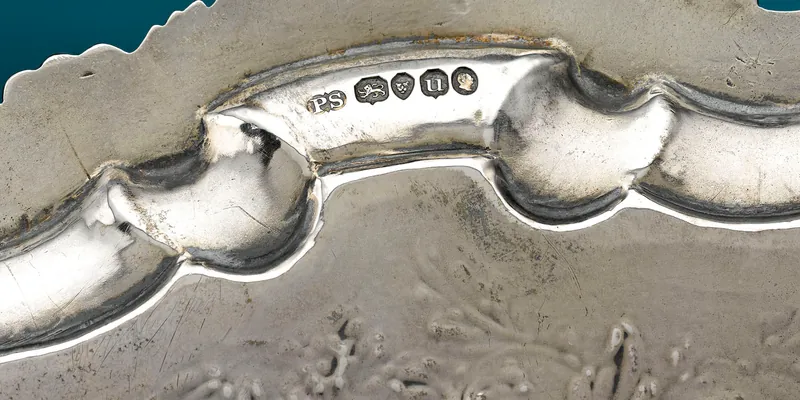
On sterling silver, the Walker & Hall mark appears alongside a full British hallmark cluster: the lion passant, the Sheffield town mark (a crown until 1975, then a White Rose), and a date letter. On silver plate the same maker’s mark appears alongside EPNS (Electroplated Nickel Silver) or A1 (Sheffield’s highest plating grade) — but NO lion passant or assay office mark. If you see the Pegasus with EPNS but no lion, you have Walker & Hall silver plate, not sterling. Our EPNS, EP, A1 and EPBM guide covers the plate marks in detail.
Mappin & Webb silver marks
Mappin & Webb was founded in Sheffield in 1859 by Joseph Mappin (with his brothers) and, from 1860, in partnership with George Webb of London. The firm became one of the most prestigious 19th-century silversmiths, holding Royal Warrants from Queen Victoria onwards. Their maker’s marks are more varied than Walker & Hall’s, changing multiple times across the firm’s long history:
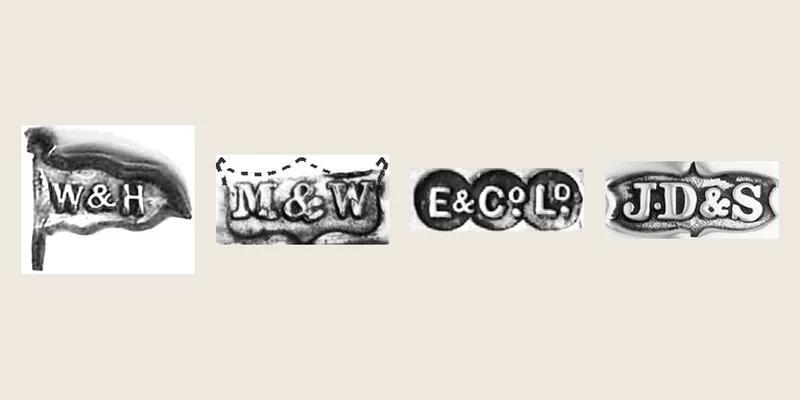
- M&W in a rectangular or shaped punch — the most common configuration on sterling silver from the 1870s onwards
- M.&W. with periods — occasional variant
- Mappin Brothers or MB — the earlier firm before the merger with Webb (pre-1860)
- MAPPIN & WEBB spelled out — on larger pieces and 20th-century items
- Prince of Wales feathers alongside M&W — on pieces made under the Royal Warrant for the Prince of Wales
Mappin & Webb registered marks at all four active British assay offices (London, Birmingham, Sheffield, Edinburgh), so the town mark on any piece tells you where it was assayed. London-marked pieces (leopard’s head) are the most common in the firm’s premium sterling lines; Sheffield-marked pieces (crown or White Rose) are more common on volume tableware. Silver plate by Mappin & Webb uses the same maker’s mark alongside EPNS or EP without any lion passant.
How to tell sterling from silver plate on either maker
The presence or absence of an assay-office hallmark cluster is what separates sterling from plate on both firms:
- Sterling silver — maker’s mark (Pegasus+W&H or M&W) PLUS lion passant PLUS town mark PLUS date letter. Four separate punches, cleanly struck.
- Silver plate (EPNS or A1) — maker’s mark PLUS EPNS/A1/EP letters. No lion passant, no town mark, no date letter. These pieces were never submitted to an assay office.
- Old Sheffield Plate (very rare on Walker & Hall / Mappin & Webb pieces) — pre-1840, uses different marks specific to the fused-plate technique. Both firms mostly worked in electroplate rather than Old Sheffield.
For a broader explainer on the sterling-vs-plate distinction, see our sterling silver vs silver plated guide.
How to date Walker & Hall and Mappin & Webb pieces
On sterling pieces, the date letter next to the lion passant pins the year within a decade against the assay office’s cycle chart. On silver plate, dating is harder because there’s no date letter — you rely on the maker’s mark variant, the pattern number (both firms used sequential pattern numbers), and the design style:
- Walker & Hall — the Pegasus-only mark (no W&H letters) tends to indicate earlier pieces (~1845–1870); the combined Pegasus+W&H became standard from the 1870s onwards
- Mappin & Webb — Mappin Brothers marks (pre-1860) are earliest; the "M.&W." variant with periods is roughly late-Victorian; the sans-serif M&W is Edwardian and later
- Design style — heavy ornament and pierced work suggest 1870s–1890s; angular Aesthetic-movement forms suggest 1880s–1900; sparse Art Deco with geometric handles suggests 1920s–1935
- Pattern numbers — some silversmiths’ reference sites cross-reference pattern numbers to production dates for both firms; silvermakersmarks.co.uk is the standard online lookup
Not sure if the mark on your piece is a Walker & Hall Pegasus or a different maker? Our silver hallmark identifier reads maker marks from a photo, cross-references them against our full British silversmith database, and returns the firm, era, and standard.
Identify the maker →Walker & Hall silver value: 2026 UK auction ranges
Walker & Hall pieces sit in the "recognised Victorian maker" tier — 2–3× melt value for sterling, at market rates for plate. Typical 2026 UK auction:
- Sterling tea service (4-piece + tray) by Walker & Hall — £2,000–£5,000
- Sterling salver / tray, presentation-quality Victorian — £400–£1,200
- Sterling cutlery canteen (12 covers) by Walker & Hall — £1,500–£4,000
- EPNS cutlery canteen (12 covers) — £80–£250
- EPNS/A1 tea service — £80–£300
- Individual EPNS piece (single teapot, cream, salver) — £20–£80
Mappin & Webb silver value: 2026 UK auction ranges
Mappin & Webb commands a modest premium over Walker & Hall on comparable pieces because of the Royal Warrant heritage and the London-marked sterling lines. Typical 2026 UK auction:
- Sterling tea service (4-piece + tray) by Mappin & Webb — £2,500–£6,500
- Sterling salver / tray, Edwardian presentation-quality — £500–£1,800
- Sterling cutlery canteen (12 covers) — £2,000–£5,500
- Sterling christening cup, small hollowware — £150–£500
- EPNS cutlery canteen (12 covers) — £100–£300
- EPNS tea service — £100–£350
- Royal Warrant-period sterling with Prince of Wales feathers — premium of ~30% over standard M&W sterling of the same period
For the full framework on setting a number on any silver piece — sterling or plate — see our antique silver valuation guide. For tea services specifically, our silver tea service value guide covers the five value drivers in depth.
Frequently Asked Questions
What is the Walker & Hall silver mark?
Walker & Hall (Sheffield, established 1845) registered a Pegasus — a winged horse — in a shaped punch as their maker's mark, usually alongside the initials W&H. On sterling pieces this mark appears with a full British hallmark cluster: lion passant, Sheffield town mark (crown pre-1975, then White Rose), and date letter. On silver plate the same maker's mark appears alongside EPNS or A1 — no lion passant, no assay office mark.
What is the Mappin & Webb silver mark?
Mappin & Webb (Sheffield, established 1859) used variants of M&W or M.&W. in rectangular or shaped punches, sometimes with a shield or the Prince of Wales feathers indicating pieces made under Royal Warrant. On larger and later pieces the full 'MAPPIN & WEBB' spelled out appears. The firm registered marks at all four active British assay offices, so the town mark on any sterling piece tells you where it was assayed.
How can you tell if Walker & Hall or Mappin & Webb silver is sterling or plate?
Look for the lion passant. Sterling silver by either firm carries a full British hallmark cluster: maker's mark (Pegasus+W&H or M&W) plus lion passant plus town mark plus date letter — four separate punches. Silver plate by either firm carries the maker's mark plus EPNS, A1 or EP letters, but NO lion passant, NO town mark, and NO date letter. If you see the Pegasus or M&W alongside EPNS but no lion, you have silver plate.
How much is Walker & Hall silver worth?
Walker & Hall sterling pieces typically sell at 2–3× melt value at UK auction. A four-piece sterling tea service with tray reaches £2,000–£5,000; a sterling salver £400–£1,200; a sterling 12-cover cutlery canteen £1,500–£4,000. EPNS pieces are worth much less — a 12-cover EPNS cutlery canteen fetches £80–£250; an EPNS tea service £80–£300; individual EPNS pieces £20–£80. Condition, completeness, and pattern rarity move prices within these ranges.
How much is Mappin & Webb silver worth?
Mappin & Webb sterling commands a modest premium over Walker & Hall because of the Royal Warrant heritage. A four-piece sterling tea service with tray typically sells for £2,500–£6,500 at UK auction; a sterling salver £500–£1,800; a sterling 12-cover cutlery canteen £2,000–£5,500. EPNS pieces sit at £100–£350 depending on set completeness. Pieces stamped with the Prince of Wales feathers command an additional ~30% premium.
How do I date a Walker & Hall or Mappin & Webb silver plate piece?
Silver plate carries no date letter, so dating relies on the maker's mark variant, pattern number, and design style. For Walker & Hall, the Pegasus-only mark (no W&H letters) suggests earlier pieces (~1845–1870); combined Pegasus+W&H was standard from the 1870s. For Mappin & Webb, 'Mappin Brothers' marks predate 1860; M.&W. with periods is roughly late-Victorian; sans-serif M&W is Edwardian or later. Look up specific pattern numbers at silvermakersmarks.co.uk.
Conclusion
Walker & Hall and Mappin & Webb were the two largest producers of Victorian and Edwardian British silver — and the Pegasus + W&H mark and the M&W mark together account for a huge share of the sterling and silver-plate pieces still in circulation. Once you can spot each firm’s trademark configuration and separate the sterling-hallmark cluster from the plate-only stamp, dating and valuing a piece becomes straightforward. Walker & Hall pieces sit at 2–3× melt in sterling; Mappin & Webb slightly higher with the Royal Warrant premium; plate from either firm at £10–£300 depending on completeness.
For a specific estimate on your Walker & Hall or Mappin & Webb piece with comparable recent auction results, upload photos of the base marks to our free AI silver appraisal.
925s.ai provides AI-assisted appraisals for informational purposes. For certified valuations, consult an accredited appraiser.
Continue Reading