First appraisal free · No credit card · Results in under 3 minutes
Silver Hallmark Identifier — Marks, Maker & Auction Value From a Photo
Upload a photo of any silver mark. Our AI silver hallmark identifier reads the marks, attributes the maker, and returns a value range built from real auction records — with a PDF report a dealer or insurer will accept.
Lion passant, anchor, leopard's head, date letters, zolotnik numbers, Minerva head, Kokoshnik mark — the AI cross-references British, French, German, American, Russian, Scandinavian, and Italian hallmark systems. Alongside identification, you get comparable auction results for pieces like yours and a downloadable PDF report. Your first appraisal is free with a free account — no credit card.
Identify My Silver Hallmark Now →Get a hallmark identification, maker attribution, market value estimate, and a downloadable PDF report.
What the silver hallmark identifier finds
✦
Purity standard
925 (sterling), 800, 830, 900, 950, 958, zolotnik 84/88/91 — the identifier recognises every major silver purity standard and tells you which one your piece carries.
⚓
Assay office
Birmingham anchor, London leopard's head, Sheffield crown, Edinburgh castle, Chester, Glasgow — and continental equivalents. The identifier names the office that struck the mark.
📅
Date letter
British silver carries a single letter for each hallmarking year. The identifier reads the letter, font, and shield shape, and pinpoints the year — usually to within 12 months.
🔨
Maker's mark
The two- or three-initial sponsor mark gets cross-referenced against international maker databases. If your piece is by a known silversmith, the identifier tells you who.
🌍
Country of origin
British, French, German, American, Russian, Italian, Dutch, Scandinavian, Spanish — the identifier recognises each tradition's distinctive marking system, even on unfamiliar pieces.
£
Market value estimate
The identification feeds into a live auction-comparable search. You get an estimated value range based on real sale prices for similar pieces by the same maker.
Simple process
How It Works
Photograph the mark
Take a clear close-up of the hallmark — 2-3 photos help if there are multiple marks in a row. Even a smartphone macro shot is enough.
AI reads the marks
The identifier runs your photo through hallmark databases for every major silver tradition, cross-references the marks, and verifies the identification against web sources.
Get the full report
Standard, assay office, year, maker, country, and estimated market value — all on screen in under 3 minutes, plus a downloadable PDF report.
Reference
Common Silver Hallmarks at a Glance
A quick reference to the marks the AI silver hallmark identifier most often sees. If your piece carries any of these, the identifier will name them, place them, and tell you what they mean for the metal beneath.
Lion passant
Sterling silver · Britain
A walking lion with one paw raised. Introduced in 1544 and still in use today, this mark guarantees the piece is 92.5% pure sterling silver — the British standard for solid silver. Any piece of British silverware carrying the lion passant has been tested and stamped by an official assay office.
Leopard's head
London Assay Office
A crowned leopard's head (crown removed after 1821) is the town mark of the London Assay Office — the oldest continuously operating assay office in the world, established in 1300. If your piece carries a leopard's head alongside a lion passant, it was hallmarked in London.
Anchor
Birmingham Assay Office
A plain anchor is the town mark for Birmingham, established in 1773. Birmingham handled enormous volumes of small silverwork — jewellery, snuff boxes, table silver — so an anchor + lion passant combination is one of the most common British hallmark clusters you'll encounter.
Crown
Sheffield Assay Office (pre-1975)
A five-point crown was Sheffield's town mark from 1773 until 1975, when it was replaced by the Yorkshire White Rose. Sheffield specialised in cutlery and flatware, so a crown mark on the base of a spoon, fork, or knife blade is almost certainly a Sheffield-assayed piece.
Thistle / castle
Edinburgh Assay Office
A three-towered castle is Edinburgh's town mark. From 1759 onwards a thistle was added as the sterling purity mark (replacing the lion passant that English offices use). A thistle-and-castle cluster tells you the piece is Scottish sterling.
925 / .925
Sterling silver · international
The numeral 925 is the international fineness mark for sterling silver — 925 parts pure silver per 1,000. Used on American, European, and modern British pieces where the traditional pictorial marks are not required. Any piece stamped "925" or ".925" is 92.5% pure silver.
800 / 830 / 900
Continental silver
Continental European standards for solid silver at lower purity than sterling: 80%, 83%, or 90% silver respectively. Common on German, Italian, Scandinavian, and Eastern European pieces. Still solid silver throughout, still valuable — just at a lower fineness than the British 925 standard.
EPNS / EPBM / EP
Silver plate · not solid silver
Electroplated Nickel Silver, Electroplated Britannia Metal, and Electroplated. These are NOT sterling — they are base-metal pieces with a thin layer of silver bonded to the surface. If you see these marks, the piece is silver plate, worth a fraction of a comparable sterling item. See our EPNS guide for a full breakdown.
Sovereign's head
Duty mark · Britain 1784–1890
A stamped profile of the reigning monarch's head, used only between 1784 and 1890 to show that excise duty had been paid on the piece. Finding one dates your silver to the Georgian or Victorian era with high precision — pieces after 1890 do not carry it.
Getting the best result
How to Photograph Your Silver Hallmark
A clear photograph is 90% of a clean identification. Three quick habits make the difference between "identified in seconds" and "worn, best-effort only".
Turn the piece over
Hallmarks live on the base of hollowware (teapots, jugs, candlesticks), on the back of a spoon's handle, on the underside of a bowl rim, or inside a ring shank. The AI identifier reads better from the marks-only surface than from the ornamental face.
Use raking light, not straight-on flash
Hold your phone or camera at a slight angle so light rakes across the surface. Shallow stamps catch shadow and pop into legibility. A flat, overhead flash washes the marks out and hides worn detail.
Fill the frame with the marks
Zoom in until the hallmark cluster fills 60–80% of the frame. Modern phone cameras autofocus close (a couple of centimetres for macro-mode iPhones). A steady hand and good light beat a jeweller's loupe every time.
British silver
Reading British Silver Date Letters
British silver has carried a date letter since the 15th century — a single letter, in a specific font and shield shape, punched once per hallmarking year. Each assay office ran its own cycle, so the same letter can mean different years at different offices. The AI silver hallmark identifier looks up the letter’s letterform, punch shape, and office context together to pinpoint the year, usually within 12 months. For the full walk-through of the British hallmarking system — the five marks in order, all the assay offices, and how to date any piece by cross-referencing the letter against the office’s table — see our guide to how to read British silver hallmarks. For the underlying 92.5% sterling standard that the lion passant certifies, see what does 925 mean on silver. Three worked examples from our reference set:
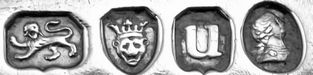
1795 · London
Letter U
An Old English capital U in a shield-shaped punch — London's 1795 date letter. This falls in the late Georgian period, when Paul Storr was beginning his career at London's Goldsmiths' Hall.

1878 · Birmingham
Letter D
A Roman lower-case d — Birmingham's letter for 1878. Birmingham silverwork of this period is often small-form: vinaigrettes, card cases, and cruet frames from Elkington and its contemporaries.
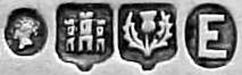
1861 · Edinburgh
Letter E
A Gothic capital E — Edinburgh's 1861 mark, mid-Victorian. Edinburgh pieces from this period typically carry the castle town mark plus a thistle purity mark, distinct from the English lion passant.
Frequently Asked Questions
How accurate is an AI silver hallmark identifier?
For clear, in-focus photos of standard British, French, German, American, or Russian hallmarks, accuracy on the purity standard and assay office is high (typically above 90%). Maker identification accuracy depends on how rare the mark is — well-documented makers like Paul Storr or Tiffany are reliably identified; obscure regional silversmiths are best-effort. Worn or partial marks reduce confidence; the report flags low-confidence identifications explicitly.
Can the identifier read worn or partial hallmarks?
Yes, up to a point. The AI is trained on the full spectrum of hallmark condition — from crisp modern stamps to badly rubbed 18th-century pieces — and can often make a strong best-guess identification from just two or three legible elements (say, the town mark and the shield shape without the date letter). Where a mark is genuinely illegible, the report says so and falls back to style-and-weight cues to give a date range and country of origin instead of a spurious "exact" reading.
What if my piece has no hallmarks at all?
Unmarked silver isn't automatically fake — Sheffield Plate (pre-1840), some very early or very small pieces, some Continental silver, and much American silver made before around 1850 all lack the official hallmark clusters familiar from British silver. The identifier examines the piece's form, weight-per-cubic-cm, patina, decorative style, and any partial marks to give a best-estimate country and period. If it can't rule out plate, it says so and points you toward the physical tests (magnet, acid, ice) that settle the question.
What if I can't see the hallmark clearly?
Take the photo in good light, ideally diagonally to the surface rather than straight on (oblique light makes shallow stamps catch shadow and become readable). A smartphone macro setting or a £5 jeweller's loupe held in front of the lens both work well. If the mark is genuinely worn beyond reading, the identifier will tell you and use other cues (weight, style, country indicators) to give a best-effort identification.
What silver hallmark systems does the identifier cover?
British (London, Birmingham, Sheffield, Edinburgh, Chester, Dublin, Glasgow), French (1798 onwards including Minerva, owl, and crab marks), German (800/835 + crescent-and-crown), American sterling/coin silver, Russian (zolotnik 84/88/91 + Kokoshnik), Italian, Dutch, Scandinavian (830/925), Spanish, and EPNS/EP/A1/EPBM silver plate marks for plated pieces.
Is the silver hallmark identifier free?
Yes — your first appraisal is free. Create a free account with Google or email (no credit card needed) and you will get a full identification: purity standard, assay office, date letter where readable, and maker attribution, plus a downloadable PDF report. After that, appraisals are $2.50 each, or less in a bundle. You are only charged if the appraisal succeeds.
What if the hallmark says EPNS, EP, or A1?
Those marks tell you the piece is silver plate, not solid silver. The identifier still identifies them and tells you the manufacturer, quality grade, and likely date. See our full guide to EPNS, EP, A1, and EPBM marks for what each one means.
Can the identifier date my silver?
For British hallmarked silver, yes — usually to within a single year by reading the date letter. For French silver, the post-1838 Minerva head + maker mark combination dates pieces to the maker's active period (often within a decade). For unmarked or pre-date-letter silver, the identifier estimates the date range from style cues, weight, and maker.
Related Reading
Guide
How to Read British Silver Hallmarks: Lion Passant, Date Letters and Assay Marks
Decode every British silver hallmark — lion passant, duty marks, date letters, assay offices, 925, and EPNS — explained with photos.
Guide
What Does 925 Mean on Silver? Hallmark, Value & Full Guide
The 925 stamp is just the start. Learn to read the full hallmark and find out what your silver is actually worth.
Guide
EPNS, EP, A1, EPBM — what do silver plating marks actually mean?
Spotted EPNS, EP, A1 or EPBM on your silverware? These marks tell you it's silver plate — find out what each means.
Ready to find out what your silver hallmark is worth?
Upload a photo. Our AI does the rest — hallmark identification, maker attribution, market value, and a downloadable PDF report. Your first appraisal is free with a free account — no credit card.
Identify My Silver Hallmark Now →A quick note on cookies
We use analytics to understand how people use 925s.ai and improve it. No tracking, no ads. Privacy policy