Free AI Silver Appraisal — Upload a Photo, Get a Valuation
Hallmark ID, maker attribution, auction comparables and a PDF report — under 3 minutes.
✦ Your first appraisal is free with a free account — no credit card. Sign in.
Upload Your Photos
Add multiple photos to each slot — more detail means a more accurate appraisal
Hallmark photos are the single biggest factor in silver identification and valuation — the difference between sterling and silver plate can be a 3–5× difference in value.
Your first appraisal is free with a free account — no credit card.
Or continue as a guest for $2.50 — only charged if the appraisal succeeds.
Sample reports
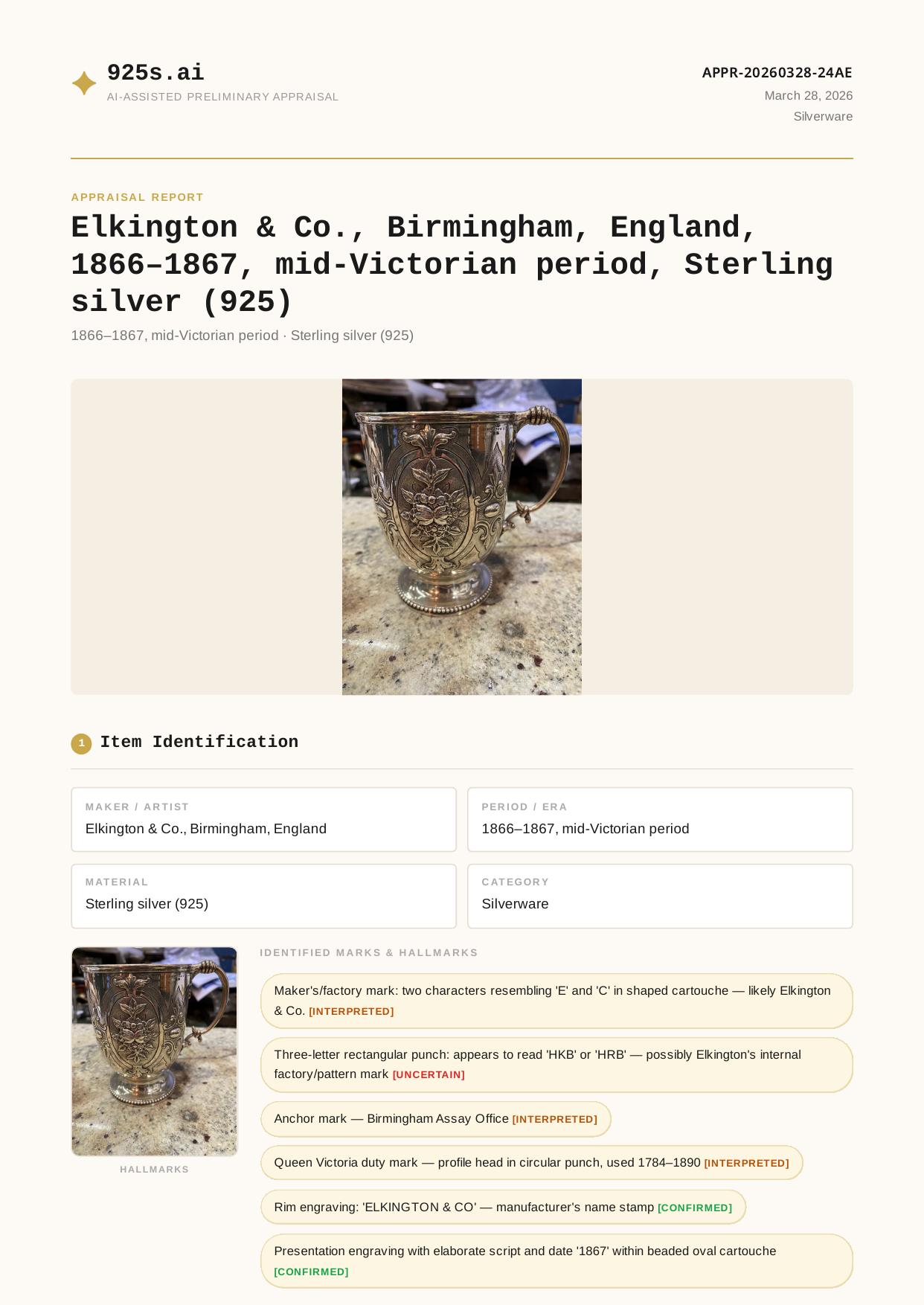
Real appraisals, unedited.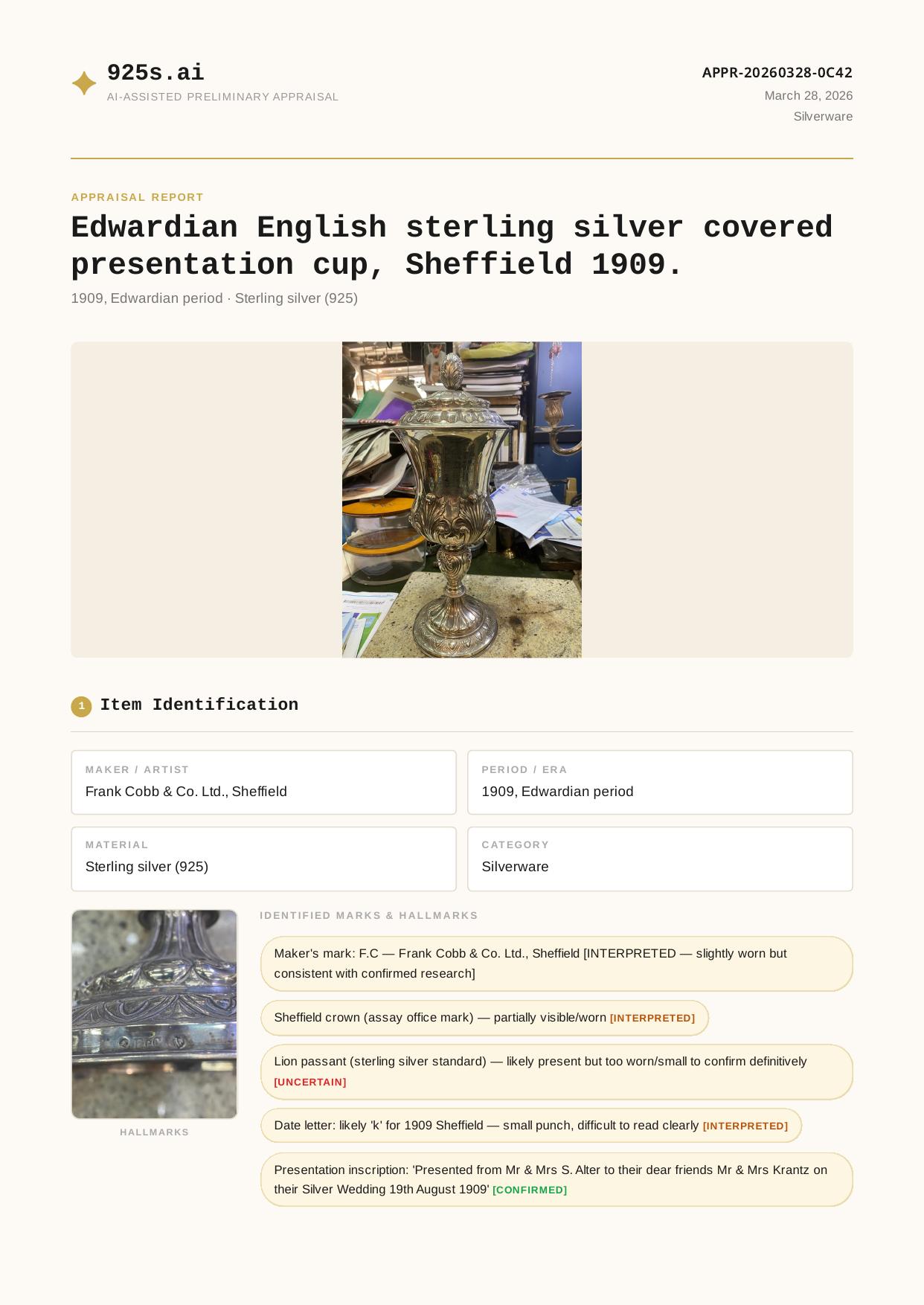
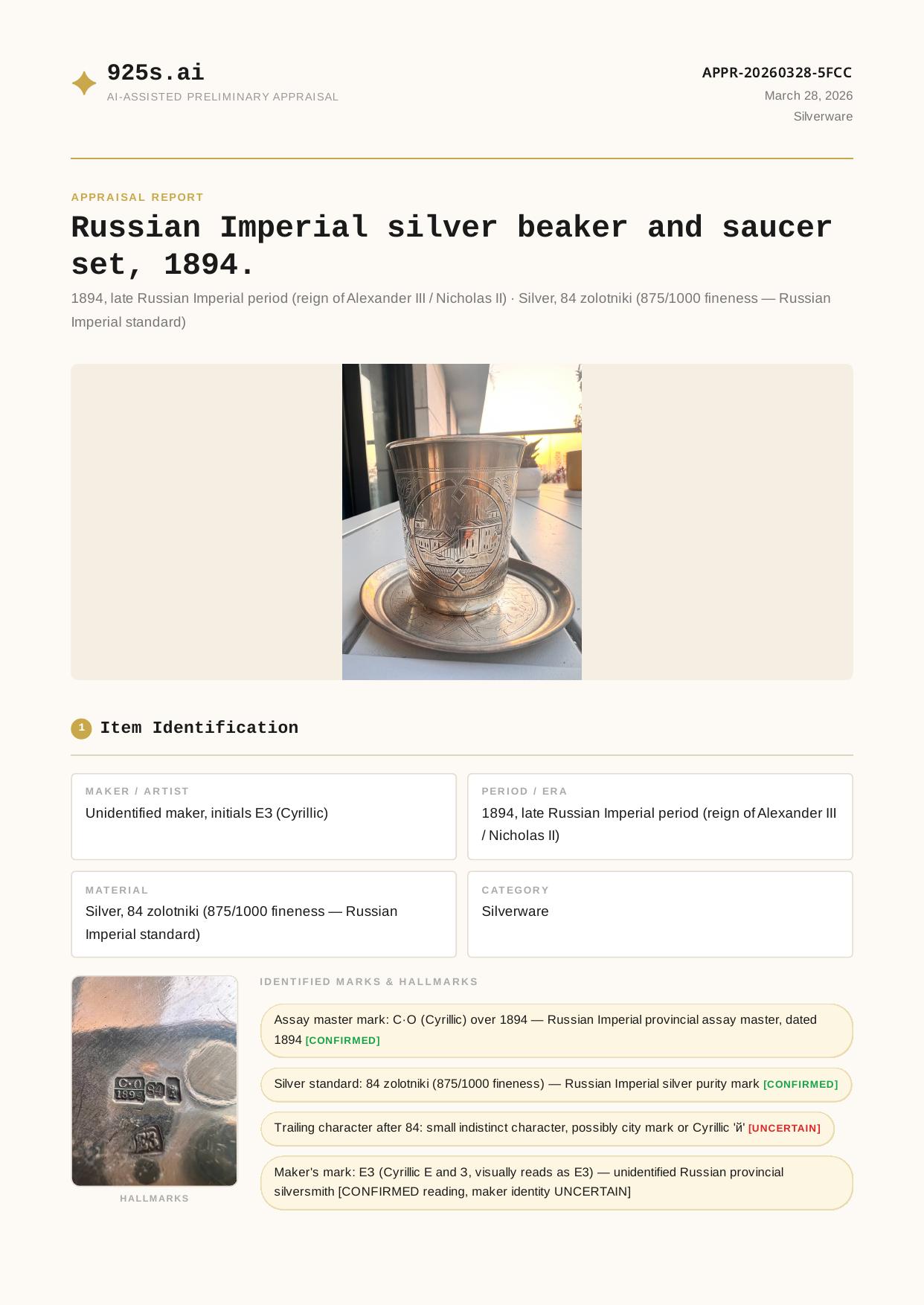
How the AI silver appraisal works
Step 1 — Upload photos. One clear photo of the whole piece is enough to get started. A second photo of the hallmark or maker’s mark (a smartphone macro shot works fine) significantly improves accuracy. If you have a weight, add it — it lets us compute a melt-value floor precisely.
Step 2 — The AI reads the marks. Our pipeline identifies British hallmarks (lion passant, assay office town mark, date letter, maker’s initials, duty mark), American and Continental purity numerals (925, 800, 830, 900, 950, 958), and silver plate marks (EPNS, EP, A1, EPBM). It works across British, American, French, German, Russian and Scandinavian silver systems.
Step 3 — Get a full appraisal in under 3 minutes. You receive a report with the identified maker (where visible), era, assay office, purity, an estimated market-value range based on comparable recent auction results, and a downloadable PDF you can share with an insurer, an auction house, or the family member who inherited the piece.
What’s in the appraisal PDF
The downloadable report contains everything the tool discovered about your piece, in one document:
- Hallmark identification — every legible mark decoded with its meaning, provenance, and confidence score
- Maker attribution — where the maker’s initials match a known silversmith registry, the firm’s name, city and working dates
- Era and assay office — British pieces dated to the year via the date letter cycle; Continental pieces placed by fineness mark + style
- Value estimate — a market-value range with the reasoning behind it (silver-weight floor + maker premium + condition + completeness)
- Comparable auction results — recent sales of similar pieces from LiveAuctioneers, eBay and other tracked venues
- Photos of the piece — the images you uploaded, embedded in the PDF for reference
See what the reports look like
These are five real, unedited appraisals produced by the tool:
- Edwardian English sterling silver teapot
- Elkington & Co. Birmingham silver tray
- Russian Imperial silver beaker with Kokoshnik mark
- Tiffany & Co. sterling flatware
- Victorian cruet set by Walker & Hall
How to photograph your silver for the best result
Two photos are enough for most pieces. Both taken in natural, even light — a window on an overcast day is ideal. Avoid direct sunlight (it blows out silver’s surface highlights) and avoid overhead spotlights (they create hard reflections that hide detail).
- Whole-piece shot — the object filling the frame against a plain matte background (a folded tea towel works). Show the front + one side.
- Hallmark close-up — smartphone macro mode or a jeweller’s loupe held to the lens. Angle the piece so light rakes across the punch rather than reflecting into it. Fingernails as a scale reference are welcome.
- Weight if you have it — a kitchen scale reading in grams. Silver melt value is weight-linear, so a real weight tightens the value range dramatically.
Frequently asked questions
How accurate is an AI silver appraisal? Accuracy depends heavily on hallmark legibility. Clear hallmark photos on a fully-marked British piece: the AI identifies the maker, era, and purity with high confidence. Worn marks or unmarked continental pieces: the tool reports what it can see with an explicit confidence score, and flags what it’s uncertain about rather than guessing.
What if my piece isn’t silver? The tool identifies silver plate (EPNS, EP, A1, EPBM) explicitly and gives an appropriate value estimate. It also flags common lookalikes (nickel silver, Britannia metal, silverplate over base metal). Our guide to sterling silver vs silver plated covers the differences in detail.
Do you keep my photos? Photos are stored securely for the length of your account so you can retrieve past appraisals. See our privacy policy for the specifics.
What about really valuable pieces? For high-value pieces (Georgian silver by Paul Storr or Hester Bateman, Tiffany, Fabergé, Georg Jensen designer lines) the AI appraisal is a fast first pass. For insurance or resale at the top end, follow up with a qualified independent appraiser — the report gives you a firm baseline to bring into that conversation.
Prefer to identify just a mark first? Use the free silver hallmark identifier. Reading through Georgian, Victorian and Edwardian silver? Start with how to date antique silver by era.
A quick note on cookies
We use analytics to understand how people use 925s.ai and improve it. No tracking, no ads. Privacy policy