Silver Knowledge · 9 min read · July 2026
Georgian, Victorian and Edwardian Silver: How to Date Antique Silver by Era
Last updated
The Quick Answer
The same teaspoon design can differ several times over in value depending on whether it left the workshop under George III or Edward VII. Learning how to date antique silver comes down to two skills: reading the hallmarks and recognising the style of each era. This guide covers both for the three great English eras — Georgian (1714–1830), Victorian (1837–1901) and Edwardian (1901–1910).
Silver made in London in 1785 and silver made in London in 1885 look and feel like different substances even when the object is the same — a teapot, a candlestick, a plain teaspoon. The difference is partly craft (hand-raised vs. spun and machine-finished), partly taste (restrained neoclassicism vs. dense Victorian ornament), and partly the tiny cluster of stamps punched into the base. The good news for anyone learning how to date antique silver: the marks alone will place a British piece within a decade, and once you can read them the style becomes a second reading — a way to double-check the year and to understand why the piece looks the way it does.
How to Date Antique Silver: Start With the Hallmarks
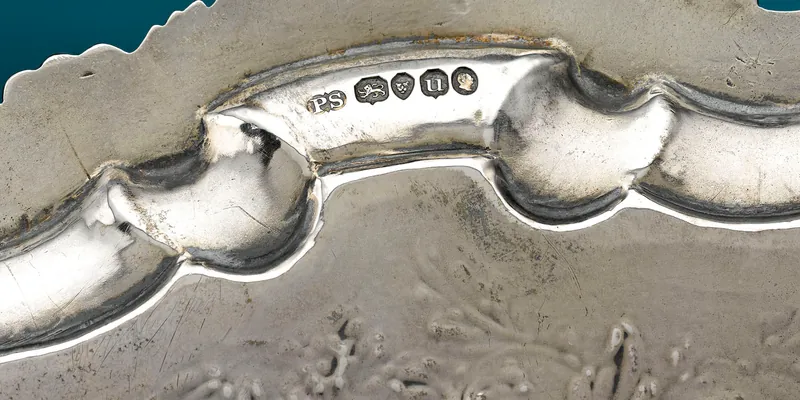
England’s date letter system was introduced in 1478 at Goldsmiths’ Hall in London — one of the oldest consumer-protection marks anywhere. The lion passant, the walking lion that certifies sterling silver, was added in 1544 and has been in continuous use ever since. Any fully hallmarked British piece carries the same four essential marks: the maker’s mark (the silversmith’s initials in a shaped punch), the standard mark (the lion passant for sterling), the assay office town mark (a leopard’s head for London, an anchor for Birmingham, a crown or White Rose for Sheffield, a castle for Edinburgh), and the date letter whose exact typeface and shield shape identify the year.
Each assay office ran its own independent date-letter cycle, so identify the town mark first, then match the letter’s style against that office’s chart. Between 1697 and 1720 the higher Britannia standard (95.8% pure silver) was compulsory for wrought plate — if you see a seated Britannia figure instead of the lion passant, either the piece falls in that window or its maker chose to work to the higher standard voluntarily after 1720. For the full walk-through of every mark and every closed office, see our full guide to reading British hallmarks, or consult the primary source: The Goldsmiths’ Company Assay Office.
The Duty Mark: The Tax Stamp That Narrows Everything Down
Between 1 December 1784 and 30 April 1890, British silver carried an extra mark that pins down the era faster than any other stamp on the piece: the reigning sovereign’s head in profile, struck to prove that excise duty had been paid. George III introduced the duty on silverware in 1784 partly to help recover the costs of the American War of Independence, and it was finally abolished in 1890.
That single mark separates most Georgian and Victorian pieces at a glance. No duty mark generally means the piece is either pre-1784 or post-1890. A king’s head means somewhere in 1784–1837 — the reigns of George III, George IV or William IV — and from 1786 onwards those royal profiles face right. Queen Victoria’s head, which faces left, places the piece between 1837 and 1890. Combined with the office town mark, that one profile can narrow a piece to a decade before you even look up the date letter.
Georgian Silver (1714–1830): Three Styles in One Era

The Georgian era covers the reigns of the four Georges — George I (1714–1727), George II (1727–1760), George III (1760–1820) and George IV (1820–1830) — and often the reign of William IV (1830–1837) is folded in as “late Georgian.” Across that long span, style moved through three distinct phases. Early Georgian work continued the plain, poised elegance of Queen Anne silver: hexagonal teapots, simple mouldings, uninterrupted expanses of polished metal. From around 1725 the Rococo took hold — asymmetric scrolls, shell and cartouche work, cast-and-applied ornament — and found its greatest exponent in Paul de Lamerie (1688–1751), whose maker’s mark was registered in 1712 and whose pieces are still among the most sought-after British silver ever made.
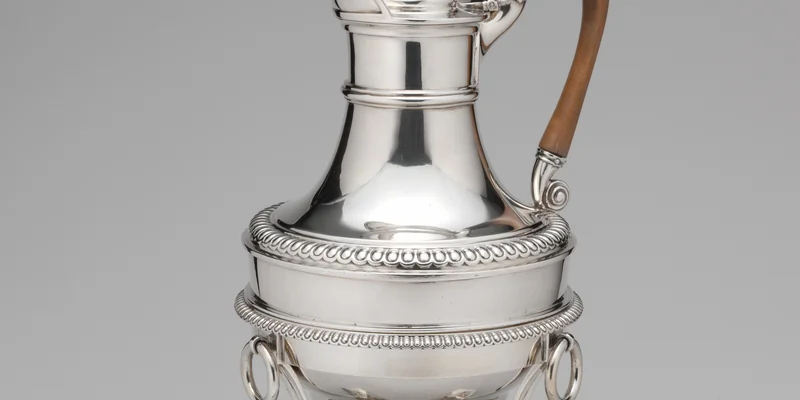
After 1760 taste swung the other way. Neoclassicism replaced Rococo curves with urns, swags, oval medallions and long straight lines drawn from newly-excavated Roman remains. The Regency period under George IV then added weight and gravitas: heavier gauges, cast borders, architectural forms. Paul Storr — whose Regency-period work is on display at the Metropolitan Museum of Art (see the 1807–8 hot water jug pictured here) — represents that late Georgian grandeur. Whatever the sub-style, Georgian silver is entirely hand-wrought, which is why collectors prize it above almost any later era.
Victorian Silver (1837–1901): Ornament and the Machine Age

Victorian design was famously eclectic. Where Georgian silver moved through a handful of major styles across a century, Victorian silver reached for every style at once — Gothic Revival in the 1840s, Renaissance and Rococo revivals in the 1850s and 1860s, dense naturalistic flowers and vines in raised repoussé work by the 1870s, aesthetic-movement influences in the 1880s. The result was silver that told you at a glance it was Victorian: heavy, ornamented, often engraved to the last quarter-inch of the surface.
Behind the ornament sat a technical revolution. George Richards Elkington of Birmingham secured the master patent for electroplating in 1840 and licensed it widely, and within a generation silver-looking tableware became affordable to the middle classes for the first time. That changes what you have to check on a Victorian-era piece. Full British hallmarks with Victoria’s head mean sterling silver. “EPNS,” “EP,” or a maker’s stamp with no assay office mark means electroplate — base metal with a thin silver skin, worth a fraction of the sterling equivalent. For the full plate-mark breakdown — what each of EPNS, EP, A1 and EPBM actually means and how to date each — see our dedicated guide. For the deep dive on Elkington’s process and its transformation of the trade, see The Victorian Web.
Edwardian Silver (1901–1910): A Lighter Touch

After Victoria’s death in 1901, taste swung away from ornament almost as sharply as it had swung towards it seventy years earlier. Edwardian silver favours lighter gauges, delicate pierced work, and a revival of 18th-century Adam-era neoclassical motifs: garlands of laurel, ribbons, swags, oval medallions. Elegance over opulence.
Confirming a piece as Edwardian is straightforward. There will be no duty mark — that stamp was abolished in 1890, more than a decade before Edward VII came to the throne — and the date letter will fall in the Edwardian window of whichever office assayed the piece. Edwardian silver has a modest but honourable status among collectors: it is the youngest silver still comfortably classed as “antique” under the common hundred-year rule.

Frequently Asked Questions
How can I tell how old my antique silver is?
Read the hallmarks: identify the assay office town mark first, then match the date letter's font and shield shape against that office's chart to get the year. The presence or absence of the sovereign's-head duty mark (1784–1890) narrows it immediately. Style is the cross-check, not the primary evidence.
What is the difference between Georgian and Victorian silver?
Era (1714–1830 vs 1837–1901), method (entirely hand-wrought vs increasingly industrial), and typically style: Georgian ranges from plain Queen Anne elegance to neoclassical restraint; Victorian tends towards heavy, eclectic ornament. The duty mark's monarch settles it: a king's head is Georgian-era, Victoria's left-facing head is Victorian.
Is Georgian silver worth more than Victorian silver?
Often, because it is scarcer and hand-made, but not always: top Victorian makers and exceptional pieces can outprice ordinary Georgian ones. Condition, maker and form matter more than era alone.
What does the monarch's head mean on silver?
It is the duty mark, struck between 1784 and 1890 to show excise tax was paid. It both authenticates the piece and dates it to that window — a king's head means 1784–1837, Queen Victoria's left-facing head means 1837–1890.
How do I know if my silver is Edwardian?
Look for an Edward VII-period date letter (1901–1910), no duty mark (that stamp was abolished in 1890), and lighter garland-style decoration reviving 18th-century Adam-era motifs — ribbons, swags, laurel wreaths — rather than the heavier Victorian ornament that preceded it.
Why doesn't my silver have a date letter?
It may be electroplate (EPNS), foreign, or made after 1999 when the UK date letter became optional; some small pieces were also exempt from full marking. A missing date letter doesn't mean the piece is fake — it means you date it by other evidence: style, form, maker's mark, and any partial hallmarks.
Conclusion
Hallmarks give the year; style gives the story. The two together tell you almost everything worth knowing about an English silver piece: who made it, in which assay office it passed the standard, whether the reigning monarch had already introduced (or abolished) duty on silverware, and what fashion was doing at the moment the maker punched the last mark. Once you can read the four (or five, with duty) stamps and recognise the eras’ visual signatures, most British silver becomes legible on sight.
If you have a piece in hand and don’t want to work through the tables yourself, 925s.ai’s free AI appraisal reads the hallmarks from a photograph and estimates the era, maker and value in seconds — first one is on us, no card required.
925s.ai provides AI-assisted appraisals for informational purposes. For certified valuations, consult an accredited appraiser.
Continue Reading