Silver Knowledge · 8 min read · July 2026
How to Identify Silver: A Practical 5-Step Guide
Last updated
The Quick Answer
To identify silver, turn the piece over and look for stamped marks first. A number like 925, the word "Sterling", or a British lion passant confirms solid silver. Marks like EPNS, EP, A1, or EPBM mean silver plate. If there are no legible marks, three home tests settle it: silver is non-magnetic, it’s dense (10.5 g/cm³), and it rings clearly when tapped.
Silver identification is a five-step process. Read the marks (this settles 90% of pieces in under a minute), run three physical tests if the marks are unclear or missing, place the piece in an era from the style and the mark cluster, identify the maker from the trademark, and then estimate value. Each step narrows the answer, and none of them requires anything you don’t already own — a strong magnet, a kitchen scale, and a smartphone camera cover almost every case.
Step 1: Read the marks
The base of a piece of silver — or the back of a handle, the underside of a foot rim, the inside of a ring shank — carries the metal’s complete identification in a cluster of tiny stamps. This is the fastest, most reliable identification method, and modern smartphone macro cameras read hallmarks better than most jewellers’ loupes.
Sterling silver marks:
- 925 or .925 — the international numeral for 92.5% pure silver. Standard on American, modern British, and export silver.
- "STERLING" — the alphabetic form of the same standard. Common on American and export pieces.
- Lion passant — a walking lion, in continuous use on British silver since 1544. Certifies the same 92.5% standard.
- 800, 830, 900, 950 — Continental European fineness marks (80% to 95% silver). All solid silver at lower purity than sterling.
- 958 or seated Britannia figure — British Britannia silver, 95.8% pure. Higher than sterling; optional standard since 1720.
Silver plate marks (not solid silver):
- EPNS — Electroplated Nickel Silver. The most common British silver-plate mark.
- EP — Electroplated (base metal unspecified).
- A1 — Sheffield’s highest plating quality grade. Still plate.
- EPBM — Electroplated Britannia Metal. Tin-based base, usually hollowware.
- "Silver Plate", "Triple Plate", or a name-only stamp with no purity number.
Each of these plate marks encodes a specific base metal + plating technique, and each has its own value range at auction. Our full guide to EPNS, EP, A1 and EPBM silver plate marks covers what every stamp means and what pieces stamped with each are worth in 2026.
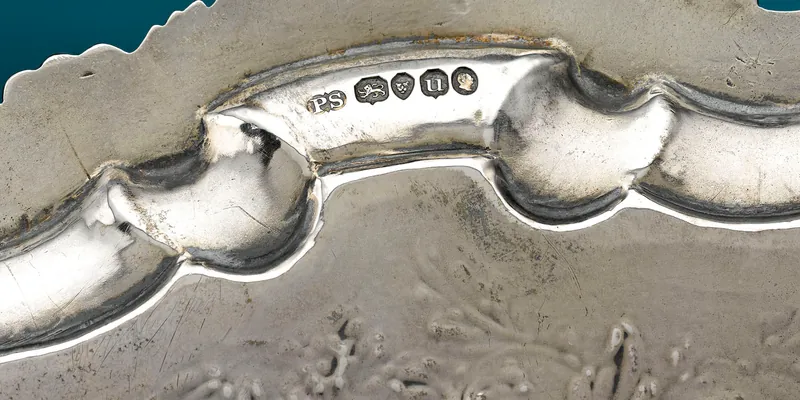
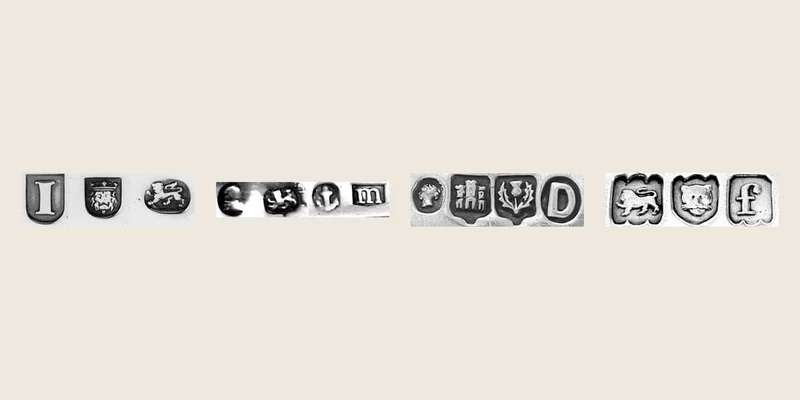
For a piece to be British hallmarked silver it must carry four marks in a cluster: the maker’s initials, the lion passant, the assay-office town mark, and a date letter. See our full guide to reading British silver hallmarks for the town-mark chart and every date-letter cycle.
Step 2: Run three tests when marks are unclear
Marks worn beyond reading? Three physical tests, done in under five minutes with items on any kitchen counter, settle whether a piece is silver.
The magnet test. Hold a strong magnet (a rare-earth or neodymium button magnet from a hardware store) close to the piece. Silver is non-magnetic in all its forms; if the piece pulls firmly toward the magnet, it contains ferrous base metal and is not solid silver. A weak or absent magnetic response doesn’t confirm silver on its own (copper and brass are also non-magnetic), but a positive response definitively rules it out.
The weight test. Sterling silver has a specific gravity of 10.5, making it denser than the base metals used in plating (copper 8.9, nickel 8.9, brass 8.5, Britannia metal 7.3). A sterling piece has an unmistakable heft — you notice it in the palm before you weigh it. Silver-plate over Britannia metal in particular feels light and slightly hollow. The weight test needs calibration, which is why picking up known sterling at an antiques fair once or twice is instructive.
The ping test. Tap the piece gently with a fingernail or another metal object. Sterling silver rings clearly for a full second or two before fading — a bell-like note. Silver plate over base metal produces a dull thud; the base metal dampens the resonance. This test works best on hollowware (bowls, teapots) and coins; less well on flatware, where the shape doesn’t sustain resonance. Our guide to spotting fake silver covers all seven home tests including the acid test and pseudo-hallmark detection.
Step 3: Place the era from style and marks
Once you’ve confirmed the piece is silver, the marks and the style together place it in an era. British silver runs through five great periods, each with a visual signature and a hallmark cluster you can spot at a glance. Our full guide covers this in detail: how to date antique silver: Georgian, Victorian, Edwardian by era.
Quick era read from hallmarks alone:
- A sovereign’s head mark (king or queen in profile) — the piece was made and hallmarked between 1784 and 1890, when duty was payable.
- Seated Britannia figure instead of lion passant — either the 1697–1720 mandatory Britannia standard period, or the optional 958 standard used voluntarily since.
- No hallmarks at all + no maker mark — either silver plate, or an unmarked continental piece (some Scandinavian and colonial silver is un-marked but genuine).
Step 4: Identify the maker
The maker’s mark — typically two or three initials in a shaped punch — is the most valuable stamp on any piece, because a recognised maker can multiply the value by 5–20 times over the melt value of the metal itself. Look up the initials in a maker’s reference. For 19th and early 20th-century British pieces, silvermakersmarks.co.uk is the standard online reference. For older or rarer marks, Sir Charles Jackson’s English Goldsmiths and their Marks (1905, revised 1989) remains authoritative.
Top-tier makers that reliably multiply the value of a piece include Paul Storr, Hester Bateman, Paul de Lamerie, Tiffany & Co., Georg Jensen, and the leading Victorian firms Mappin & Webb, Elkington, Walker & Hall, and Christopher Dresser designs. Even without a specific maker premium, an unambiguous full hallmark cluster with clear maker’s initials commands more from buyers than a piece with a worn or missing maker mark.
Stuck reading a worn hallmark? Our silver hallmark identifier reads British, American, French, German and Russian marks from a smartphone photo — it decodes the maker, assay office, year, and purity in under a minute. Free with signup.
Identify my piece →Step 5: Estimate the value
Value falls out of the first four steps. Sterling silver has a hard floor set by the current spot price: roughly £1.40/g of sterling as scrap. Above that floor comes the maker premium, condition, completeness (a full tea service is worth more than the sum of its individual pieces), and any collector interest in the specific pattern or period. Silver plate has essentially no melt value; the pricing lever is design, maker, and condition instead. For the full valuation framework with worked examples, see our antique silver valuation guide.
Frequently Asked Questions
How do you identify silver?
Turn the piece over and look for stamped marks first — this settles 90% of cases in under a minute. A number like 925, the word 'Sterling', or a British lion passant confirms solid silver. Marks like EPNS, EP, A1, or EPBM mean silver plate. If marks are unclear or missing, run three home tests: silver is non-magnetic (a strong magnet won't stick), it's dense (10.5 g/cm³, feels heavier than expected for its size), and it rings clearly when tapped (a bell-like note lasting 1–2 seconds).
What are the marks on silver called?
The stamps on silver are called hallmarks (when applied by an official assay office) or maker's marks (when applied by the manufacturer). British hallmarked silver carries a cluster of four separate marks: the maker's initials, the lion passant standard mark, the assay-office town mark (leopard's head for London, anchor for Birmingham, crown or White Rose for Sheffield, castle for Edinburgh), and a date letter identifying the year.
What does 925 mean on silver?
925 is a millesimal fineness mark — it means the piece contains 925 parts silver per 1,000 by weight, or 92.5% pure silver. This is the international standard for sterling silver, used on American, modern British, and export silver. The remaining 7.5% is typically copper added for durability. Any piece stamped 925, .925, or 'Sterling' is solid sterling silver — not plate.
Does a magnet stick to real silver?
No. Silver is completely non-magnetic in all its forms. If a magnet clings firmly to a piece marked 'silver', it contains ferrous base metal underneath and is either silver plate over steel or an outright fake. A weak or absent magnetic response doesn't confirm silver on its own (copper and brass are also non-magnetic), but a positive response definitively rules it out.
How can you identify silver without hallmarks?
Three physical tests work when marks are missing. Magnet test: silver is non-magnetic — any firm pull toward a strong neodymium magnet means base metal underneath. Weight test: sterling silver (10.5 g/cm³) is denser than the metals used in plating (copper 8.9, nickel 8.9, brass 8.5); a sterling piece feels heavier than expected for its size. Ping test: tap the piece with a fingernail — sterling rings clearly for 1–2 seconds; plate produces a dull thud because the base metal dampens the resonance.
Conclusion
Identifying silver is a decision tree, not a mystery. Marks first; tests when marks are missing; era and maker to sharpen the picture; value at the end. Every step uses information that the piece itself is telling you — you just have to know what to look at and what each signal means. Once you can read the four British hallmark stamps and recognise the plate marks that look like sterling but aren’t, most silver identifies itself in seconds.
If a piece is worn, unusually stamped, or you just want a second opinion, our AI silver appraisal reads the marks from a photo and returns a full identification with era, maker where identifiable, and market value in minutes. Your first appraisal is free with a free account — no credit card.
925s.ai provides AI-assisted appraisals for informational purposes. For certified valuations, consult an accredited appraiser.
Continue Reading