Silver Knowledge · 10 min read · June 2026
Tiffany & Co Silver Marks: How to Authenticate a Piece
Last updated
The Quick Answer
Authentic Tiffany silver marks always include "TIFFANY & CO." plus a fineness stamp ("STERLING", "925", or "STERLING SILVER 925/1000"). Genuine stamps are crisp and deep, with a "T" and "C" slightly larger than the other letters. Pieces made between roughly 1854 and 1965 also carry an Old English date letter; an "M" means Edward C. Moore's workshop, before 1891.
A Tiffany stamp can multiply a silver piece's value tenfold, which is exactly why Tiffany silver marks are so often faked. The good news: genuine Tiffany follows a precise, documented marking system — one you can read for yourself in a minute or two with a clear photo of the underside. This guide walks through every mark Tiffany has used since 1851, how the date-letter system works, what the two stamped numbers actually mean, and the practical tests that separate a real Tiffany piece from a convincing fake.
By the end you'll know whether the spoon, tray or tea service in front of you is the real thing — and roughly where it sits in Tiffany's 175-year history.

An authentic Tiffany & Co. silver tray, 1893
What marks does authentic Tiffany silver carry?
Turn the piece upside down and look at the base, the underside of a handle, or the inside rim of a bowl. Authentic Tiffany silver carries the maker's name "TIFFANY & CO." alongside a fineness mark — one of "STERLING", "925", or the full "STERLING SILVER 925/1000". Nineteenth-century pieces typically show only the word "STERLING"; the explicit numeral "925" became more common from the 1990s onward, particularly on international export pieces.
Beyond the maker and fineness, fully-marked pieces also show two stamped numbers and (on items made between roughly 1854 and 1965) a single date letter. The two numbers are the key to dating: the pattern number on the upper left identifies the design, and the order number on the lower right identifies the factory order. For the underlying metallurgy of the 925 stamp itself, see our full guide to what 925 means on silver. A Tiffany piece without any fineness mark at all is the single biggest warning sign — authentic Tiffany sterling always carries one.
The Tiffany date-letter system: the secret of the "M"
Between roughly 1854 and 1965, Tiffany stamped a single letter alongside the other marks — not unlike the British assay-office date letters, but with a Tiffany-specific twist: the letter referred to a person, not a year. An Old English capital "M" means the piece was made under Edward C. Moore, the legendary craftsman who ran Tiffany's silver workshop from 1854 until his death in 1891. The 37-year span of the "M" letter is one reason an "M"-marked Tiffany piece is so common — and so eagerly collected.
After Moore's death, the date letter shifted to the initial of the company's sitting president. Charles L. Tiffany himself signed off pieces from 1891–1902; Charles T. Cook took over 1902–1907; John C. Moore (Edward's son) ran the firm 1907–1947; Louis de B. Moore from 1947–1955; and William T. Lusk closed out the system, in office until around 1965, when Tiffany discontinued the date-letter system entirely. After 1965, dating relies on the pattern number alone.
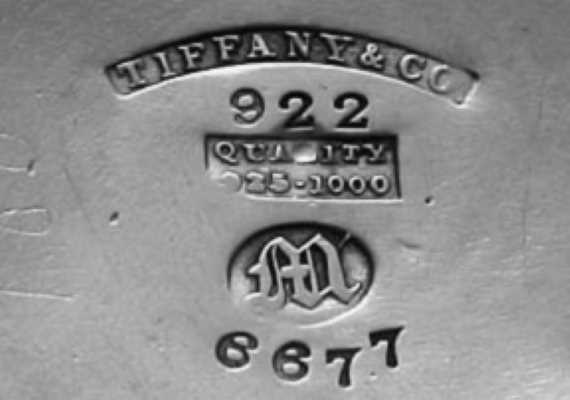
Genuine Tiffany marks: "TIFFANY & CO.", pattern no. 922, the "925-1000" quality stamp, the Old English "M" date letter, and order no. 6677
Pattern and order numbers: dating without a date letter
The two numbers stamped on a Tiffany piece are a quiet but precise dating tool, especially valuable when the date letter is worn or absent. The pattern number (upper left of the marks cluster) tracks when the design itself was first drawn into Tiffany's catalogue. The earliest pattern numbers are very low: pattern no. 1 dates to about 1851, around 10,000 corresponds to about 1890, and 15,000 sits around 1902. Higher pattern numbers were drawn later; the underlying logic is simply that Tiffany numbered designs as they registered them.
The order number (lower right) tracks the specific factory order — the moment that copy of the pattern was actually made. It tells you nothing useful about the date of design and isn't a dating tool. Tiffany's catalogue is unusually well documented, going right back to Charles Lewis Tiffany's 1851 decision to adopt the British 925/1000 sterling standard — setting Tiffany's house standard a full forty years before US sterling was federally regulated. For background on the British system Tiffany borrowed, see our guide to reading British silver hallmarks.
How to spot a fake Tiffany piece
Most counterfeit Tiffany silver gives itself away through the mark itself, not the design. Five things to check, in order of how quickly they cut a fake:
1. The stamp is sharp, deep and aligned. Genuine Tiffany marks are crisp and pressed with confident depth. Fakes typically show fuzzy or shallow stamping, occasional double-strikes, and letters that drift out of alignment.
2. The "T" and "C" are slightly larger than the surrounding letters. This is a deliberate design choice on the genuine die that fake stamps almost always miss — the counterfeit looks "evenly typeset" rather than confidently set.
3. Weight and density. Solid Tiffany sterling has a satisfying, dense feel. A worryingly light piece is often plated brass underneath, and any visible solder seams (Tiffany did very little soldering) are a near-certain tell. Plated fakes typically carry silver-plate manufacturer stamps like EPNS or A1 rather than the Tiffany hallmark cluster — see our guide to EPNS, EP, A1 and EPBM silver plate marks to recognise the substitute stamps counterfeit pieces sometimes carry.
4. The fineness mark is present. No "STERLING", no "925", no "925/1000" anywhere on the piece — even partial — means it is not authentic Tiffany sterling. If you only see "TIFFANY & CO." without a fineness mark, the piece is suspect.
5. If in doubt, do a metal test. A precious-metal acid test kit ($10–$20 on Amazon) reads the surface fineness in a minute; XRF testing at a jeweller is faster and non-destructive but costs more. Our broader guide to spotting fake silver covers the seven home tests in detail.
Not sure whether your mark is genuine? Upload a clear photo and let the free AI appraisal on 925s.ai read the mark for you — in about 3 minutes.
Try the free AI appraisal →
A genuine Tiffany & Co. sterling necklace and its branded pouch
What is antique Tiffany silver worth?
The Tiffany name lifts a piece's value far above its silver content alone. A modest Tiffany sterling spoon that would melt for fifteen dollars can comfortably sell for several hundred. The patterns drive the upper end of the market: the Chrysanthemum pattern (patented in 1880 and one of Tiffany's most labour-intensive designs) is highly collectible. As one widely-cited example, a Chrysanthemum sterling tea and coffee service from around the turn of the twentieth century sold at Bonhams for roughly $57,000 — many times the value of its silver alone.
Within the same pattern, three things move the price most: condition (dents, repairs, monogram removal all hurt), completeness (a full tea service with its original tray is worth dramatically more than the parts sold separately), and crisp, legible marks. A Tiffany piece with worn-away or doubtful marks loses much of its premium because authentication becomes harder. For the completeness side specifically — how individual pots, sugars and trays combine into a full set's price — see our walk-through of silver tea service value. For a broader look at how condition and provenance combine across silver categories, see our complete silver valuation guide.

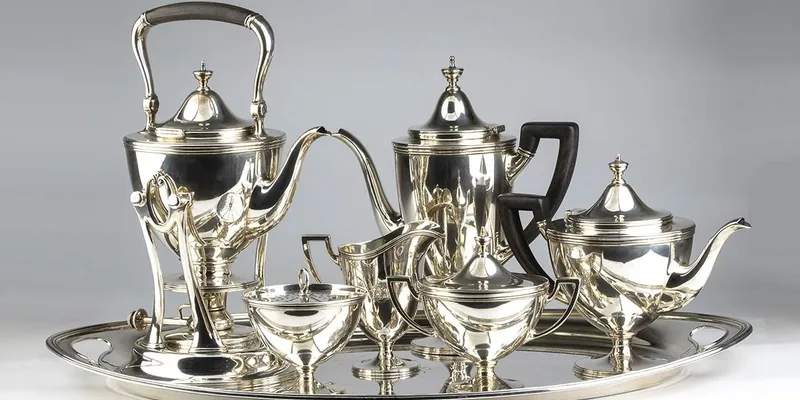
An authentic Tiffany & Co. sterling serving set, "Vine" pattern (Cleveland Museum of Art)
Frequently asked questions
How do I know if my Tiffany silver is real?
Look for a crisp "TIFFANY & CO." stamp alongside a fineness mark (STERLING, 925, or 925/1000). The stamp should be sharp and deep, aligned cleanly, with the "T" and "C" slightly larger than the surrounding letters. A blurry mark, a missing fineness stamp, or a light, hollow feel in your hand are all strong signs the piece is a counterfeit or silver plate masquerading as Tiffany.
What does the "M" mean on Tiffany silver?
An Old English capital "M" dates the piece to Edward C. Moore, the master craftsman who ran Tiffany's silver workshop from 1854 until his death in 1891. After 1891 the letter shifted to the current company president's initial — a system Tiffany discontinued around 1965. An "M" mark therefore points to one of the most collectable eras in Tiffany silver history.
Does Tiffany silver always say 925 or sterling?
Yes — authentic Tiffany sterling always carries a fineness mark, whether that's "STERLING", "925", or "STERLING SILVER 925/1000". Nineteenth-century pieces usually show only the word "STERLING"; the explicit numeral "925" became more common from the 1990s onward. A piece stamped "TIFFANY & CO." with no fineness mark of any kind is almost always either a fake or a non-silver item.
How do you date Tiffany silver?
Use the date letter first if one is present (Old English script, between 1854 and ~1965). If there's no date letter or it's unreadable, the pattern number stamped on the upper left gives an approximate year: pattern no. 1 ≈ 1851, ~10,000 ≈ 1890, ~15,000 ≈ 1902, with higher numbers being later. The order number on the lower right tracks the factory order and isn't useful for dating.
Is old Tiffany sterling silver worth anything?
Often yes — the Tiffany name commands a strong premium over the melt value of the silver alone, and sought-after patterns like Chrysanthemum can reach five-figure prices for complete services. Condition, completeness and the legibility of the marks matter most; a clean piece with a crisp Tiffany stamp from a desirable era is the sweet spot.
Did Tiffany make silver plate too?
Tiffany is famous for solid sterling, not plate — but the safest rule is always to check for a fineness mark. An unmarked piece, or one stamped with the letters EPNS / EP / A1 (which indicate electroplated silver), is worth dramatically less than genuine Tiffany sterling, even if the maker's name is present.
Putting it all together
Authenticating a Tiffany piece comes down to a sequence: look for "TIFFANY & CO." + a fineness mark, then read the date letter if there is one, then read the pattern and order numbers, then run the sharpness, weight and metal checks. Most of it takes under a minute once you know what you're looking at. A clean Tiffany piece from a sought-after pattern can be worth many times its silver-content value — and a well-faked Tiffany mark is exactly what counterfeiters target, because the upside is so high.
Authenticate your Tiffany piece — free
Your first appraisal is free with a free account — no credit card. Upload a photo — our AI reads the “TIFFANY & CO.” stamp, cross-references the date letter and pattern number, and gives you a market value against real auction comparables.
Get my free appraisal →Takes ~3 minutes. Full PDF report included.
925s.ai provides AI-assisted appraisals for informational purposes. For certified valuations, consult an accredited appraiser.
Continue Reading