Silver Knowledge · 16 min read · April 2026
How to Read British Silver Hallmarks: Lion Passant, Date Letters and Assay Marks Explained
Turn over a piece of old British silver and you will almost always find a cluster of tiny stamps punched into the metal. These British silver hallmarks are not decorative — they are a legally guaranteed record of where the object was tested, what it is made of, when it was hallmarked, and who submitted it. Understanding them transforms a confusing jumble of symbols into a precise biography of the piece in your hand. This guide decodes every mark you are likely to encounter — from the familiar lion passant to the rarer duty mark and the closed-office marks that catch even experienced collectors off guard.
What British Silver Hallmarks Actually Tell You
The British hallmarking system is the oldest consumer protection law for precious metals in the world, with roots stretching back to the 14th century. A fully hallmarked British silver piece carries up to five separate marks, each independently verifiable and each carrying distinct legal meaning.
The purity mark (the lion passant for sterling silver) tells you the silver content. The assay office mark tells you which UK testing laboratory approved the piece. The date letter tells you in which 12-month period the silver was tested. The sponsor's — or maker's — mark identifies who submitted the piece for testing. And on some pieces, a fifth mark, the sovereign's head duty mark, indicates that excise tax was paid during the period 1784 to 1890.
The very word "hallmark" comes from Goldsmiths' Hall in London. From 1478 onwards, silversmiths were required to bring their work to the Hall to be tested and stamped. That permanent assay at Goldsmiths' Hall gave us the term we still use seven centuries later.
Contrast all this with unmarked or foreign silver, where you have only the visual appearance and specific gravity to guide you. British hallmarked silver removes the guesswork entirely.
The Lion Passant: Britain's Guarantee of Sterling Silver
The most important single mark on any piece of British silver is the lion passant — a walking lion, three paws on the ground and one raised, always facing the viewer's right. This mark has indicated sterling silver (92.5% pure, or 925 parts per thousand) since 1544, when it was introduced by the Worshipful Company of Goldsmiths under Henry VIII.
The timing was deliberate. Henry VIII was actively debasing his coinage, reducing its silver content and undermining public trust in British money. The goldsmiths, whose entire trade depended on their reputation for unimpeachable quality, introduced the lion passant to make clear that silver objects — even while the coins were debased — remained genuine sterling.
One small detail helps date older pieces: from 1544 to 1821, the lion was shown "guardant," meaning the head is turned to look directly at the viewer. After 1821, the head faces forward in the direction of travel. This single change is often the fastest way to confirm whether a piece pre- or post-dates 1821.
If you see a seated figure of Britannia instead of a lion passant, the piece dates from the mandatory Britannia standard period (1697–1720). If you see no purity mark at all, the piece may be foreign, very old, or plated rather than solid silver.
Assay Office Marks: Where Your Silver Was Tested
Each UK assay office has its own distinctive town mark. Identifying the assay office mark first is the essential first step — it determines which date-letter table applies. Every office ran its own completely independent date-letter cycle, so the same letter in the same font can represent two entirely different years depending on which office struck it.
London — The Leopard's Head
London's mark is a leopard's head: a forward-facing feline face within a shield. It is the oldest assay mark in Britain, established by Edward I's statute of 1300, making it one of the earliest consumer protection marks in the world. The name comes from the medieval Latin leopart, which described a lion shown face-forward. On older London pieces (pre-1821), the leopard's head is crowned; the crown was dropped in 1821.

The photograph above shows three hallmarks on a London silver chalice cup made in 1638: the leopard's head (London assay office), the lion passant (sterling purity), and the date letter for that hallmarking year, all struck in a line. This is what to look for on the underside of a plate, inside the rim of a bowl, or along the handle of a spoon.
Birmingham — The Anchor
Birmingham's mark is an anchor — visually simple and unmistakeable. The Birmingham Assay Office opened on 31 August 1773, with the manufacturer and entrepreneur Matthew Boulton as its very first customer. The anchor was chosen at a coin toss at the Crown and Anchor Tavern in London when the Assay Act received Royal Assent on 28 May 1773 — Birmingham drew the anchor, Sheffield took the crown.

This photograph shows the complete mark sequence on a piece by Birmingham silversmith Nathaniel Mills, made in 1845: his maker's initials N·M, the lion passant, a date letter, and the Birmingham anchor — all four punched in a single row. Mills was one of the most celebrated Victorian silversmiths, best known for his silver vinaigrettes and card cases.
Edinburgh — The Three-Turreted Castle
Edinburgh's mark is a castle with three towers, in use since 1485, making Edinburgh's assay the oldest continuously operating in the UK. A thistle was added from 1759 as Edinburgh's sterling standard mark, replaced in 1975 by a lion rampant. Older Edinburgh pieces may therefore show the castle alongside a thistle rather than a lion passant — a difference that often confuses collectors expecting the walking lion.
Sheffield — The Crown and White Rose
Sheffield used a crown mark from 1773 until 1977, when it changed to the White Rose of York. Sheffield was the centre of the British cutlery and flatware trade, so Sheffield marks are extremely common on table silver — both in solid sterling and in Sheffield Plate (copper fused with a silver layer), which carries no sterling hallmark.
Closed Assay Offices: Marks You May Not Recognise
The four active offices — London, Birmingham, Edinburgh, and Sheffield — account for the vast majority of British silver. But antiques markets contain large quantities of silver tested at offices that have since closed, and their marks regularly confuse collectors.
Chester (closed 1962) used three wheat sheaves and a sword, derived from the city's coat of arms. Chester was one of the most prolific assay offices and marked an enormous volume of silver throughout the 18th and 19th centuries, particularly from the Midlands and the North of England.
Glasgow (closed 1964) is the other closed office you will encounter regularly. Its mark evolved over time but is most often seen as a tree with a bird in its branches, a bell, and a fish — the heraldic symbols of the city. Glasgow-marked silver from the late Victorian and Edwardian periods is plentiful in Scottish antiques.
Newcastle (closed 1884) used three castles. Exeter (closed 1883) used a Roman capital X or later a three-towered castle. York (closed 1857) used five lions on a cross. All three are now rare, found mainly on Georgian and early 19th century pieces.

The photograph above shows a silver thimble with two clearly punched marks: the lion passant (sterling silver) and the Chester assay mark — the shield bearing three wheat sheaves and a sword. The date letter confirms the piece was made during the Chester office's operating period. When you encounter an unfamiliar shield shape containing wheat or a fish or multiple castles, the answer is almost always one of the closed offices — and assayoffice.co.uk maintains a full index of historic marks for cross-reference.
Date Letters: Pinpointing the Year of Hallmarking
Date letters are the most information-rich, and most misunderstood, element of the British hallmarking system. With a little practice they become the single most useful tool for dating any piece of British silver to within a year.
Why they were introduced. The date letter system dates from 1478, when Goldsmiths' Hall began changing to a new letter of the alphabet each year to record which assay master had overseen the marking. If faulty or fraudulent silver was later discovered, the date letter pointed directly to the responsible warden. Over time the system evolved from an accountability mechanism into a precise annual calendar for the entire silver trade.
How the cycles work. Each cycle runs through roughly 20 to 25 letters of the alphabet before starting again from A. Not every letter appears in every cycle: J, U, and W are commonly omitted to avoid visual confusion with I, V, and N respectively, though this varies by office and era. One full cycle therefore spans approximately two decades.
The variables to check when reading a date letter are: the letter itself; whether it is upper or lower case (cycles alternate, so a capital A and a lower-case a represent different decades); the font style (Roman, italic, Old English, script — each maps to a specific cycle); the punch shape (square, shield, oval, round, cut-corner square); and the assay office, which must always be identified first.

The hallmarking year vs. the calendar year. Until 1975, the hallmarking year did not align with the calendar year. London's year ran from May to May; Birmingham's from July to July. A piece made in March and hallmarked in that month would carry the previous cycle's letter. This is why a piece described as "hallmarked 1855" might physically have been made in late 1854.
Post-1975 simplification. From 1 January 1975, all four remaining UK assay offices synchronised to a single annual date letter system, changing each January. Any British hallmarked piece from 1975 onwards is straightforward to date: find any post-1975 date letter table, cross-reference the letter, and you have the year. No office-specific lookup needed.
Reference tools. The Assay Office website (assayoffice.co.uk) provides free date letter tables for each office. Jackson's English Goldsmiths and their Marks (1905, revised 1989) remains the scholarly standard in print.
Can’t quite read your hallmarks? Upload a photo — our AI identifies British hallmarks (and most international ones) instantly, including assay office, year, and maker.
Identify my hallmarks →The Maker's Mark — Who Submitted the Piece
The maker's mark — more accurately called the sponsor's mark — identifies the individual or firm that registered with the assay office and submitted the piece for hallmarking. Since the 19th century it typically consists of two or three initials within a shaped punch, where the punch shape is as much a part of the registered mark as the letters themselves.

The photograph above shows the sponsor's mark S·M, registered in 1823 by silversmith Sampson Mordan, inventor of the propelling pencil and one of the most recognised names in Victorian silver collecting. The punch shape forms part of the official registration, distinguishing this S·M from any other firm that might have used the same initials at a different time.
One important caveat: the sponsor's mark tells you who submitted the piece for testing — not necessarily who physically made it. A retailer or importer could register a mark and send goods under their name. For tracing specific marks, the standard scholarly reference is Sir Charles Jackson's English Goldsmiths and their Marks (1905, revised 1989). The online database at silvermakersmarks.co.uk is particularly useful for 19th and early 20th century pieces.
The Duty Mark: The Sovereign's Head
Between 1784 and 1890, a fifth mark was added to British hallmarked silver: the sovereign's head, struck in a small oval or shaped punch showing the reigning monarch's profile in relief. The mark was not a quality guarantee but a fiscal one — proof that excise duty had been paid on the piece under the Silver Plate Duty Act.
Different monarchs' heads appear depending on the period: George III, George IV, William IV, and Victoria all left their profiles on British silver during this era. The direction the head faces, and subtle differences in the portrait, can help narrow the date range even before consulting a date letter table.

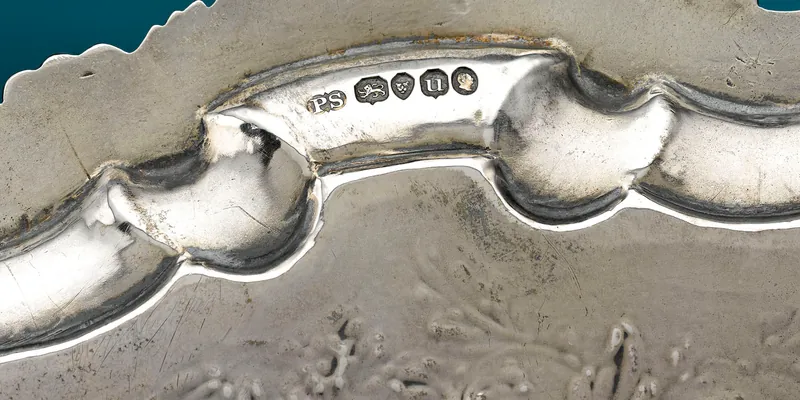
The photograph above shows five hallmarks on a piece of London silver by the celebrated silversmith Paul Storr, made in 1835. From left to right: the PS maker's mark, the lion passant (sterling silver), the London leopard's head, the date letter "u" for the 1835 hallmarking year, and the William IV duty mark — the king's profile in a shaped shield. This is the fullest mark set you will commonly encounter on high-quality English silver from this period.
The duty mark was abolished in 1890, so its presence immediately places a piece before that date — and its absence on otherwise fully hallmarked silver confirms a post-1890 piece.
The Britannia Standard — Britain's Higher-Purity Silver
Between 1697 and 1720, a higher silver standard was mandatory in England and Wales: Britannia silver, containing at least 958 parts per thousand of pure silver — significantly above the 925 of sterling.
Silversmiths had discovered that sterling silver coins could be melted down to make fashionable wrought plate, effectively destroying the currency. Parliament responded by raising the legal minimum for wrought silver above the coin standard — at 958, it was simply uneconomic to melt coins for the purpose.
During this 23-year period, the standard sterling marks were replaced. The lion passant was replaced by a seated figure of Britannia; the leopard's head was replaced by a lion's head erased — a head with a ragged cut at the neck, as if torn rather than cleanly severed. These two marks together are the definitive signature of Britannia standard pieces.

After 1720, sterling was restored as the primary standard. Britannia silver remains fully legal today — it is a voluntary choice, not a requirement. Contemporary pieces marked with the Britannia figure are made to the higher 958 standard and carry a small premium accordingly. Encountering Britannia-era marks on antique silver often surprises collectors expecting the familiar lion passant and leopard's head.
Fineness Numbers — What 925, 958, and 999 Mean on Silver
Since 1999, British law has permitted an alternative to the traditional pictorial purity marks: a simple three-digit fineness number stamped alongside the assay office mark and sponsor's mark. This numeral system is increasingly common on contemporary silver jewellery and small wares. For a broader look at what 925 means across all hallmarking traditions, see our complete guide to the 925 mark.
The numbers you will encounter are: 999 for fine silver (99.9% pure, rarely used for decorative pieces because it is too soft); 958 for Britannia standard silver; 925 for sterling silver — the most common standard for solid British silver; and 800 for lower-grade continental silver, which falls below the British sterling threshold and may be encountered on imported pieces.
The number 925 is the modern, internationally recognised expression of the same purity that the lion passant has certified since 1544. On a piece hallmarked after 1999, you may see either the lion passant or the numeral 925 — or both — alongside the assay office mark. Both are legally equivalent. On a piece made before 1999, 925 is not a British mark — it may indicate foreign silver assayed elsewhere, and should be read alongside whatever other marks appear.
Is It Real Silver? EPNS, Sheffield Plate, and Plated Marks
Not everything that looks like silver is solid silver, and the marks on plated pieces are frequently mistaken for hallmarks.
EPNS (Electroplated Nickel Silver) is a base-metal alloy coated with a thin layer of silver by electroplating. EPNS pieces are often well-made and attractive, but they contain no solid silver. The letters "EPNS" — or variants like "EP," "EPBM" (Electroplated Britannia Metal), or "A1" (a quality grade used by some manufacturers) — appear on the base rather than a purity mark. There will be no lion passant and no assay office mark. If the piece has these letters and nothing else, it is plated.
Sheffield Plate (not to be confused with silver tested at the Sheffield Assay Office) is an 18th and early 19th century material — copper bonded with a silver layer under heat and pressure, then worked like solid silver. Sheffield Plate preceded electroplating and was the dominant silverplating method from roughly 1742 to the 1840s. Genuine Sheffield Plate pieces sometimes carry a maker's stamp but never a full set of British sterling hallmarks, because the material was not submitted to an assay office.
If a piece shows a full set of British hallmarks — sponsor's mark, purity mark, assay office mark, and date letter — it is solid silver (or gold or platinum). If it shows only manufacturer's marks, trade names, or the letters EPNS, it is plated. There is no middle ground in the British system.
Frequently Asked Questions About British Silver Hallmarks
What does the lion passant mean on silver?
The lion passant is the British mark for sterling silver — 92.5% pure silver (925 parts per thousand). A walking lion with one paw raised, it has appeared on British sterling silver since 1544 and remains the standard purity mark today.
How do I date antique silver using hallmarks?
First identify the assay office mark — London's leopard's head, Birmingham's anchor, Edinburgh's castle, or Sheffield's crown/White Rose. Then look up the date letter in that office's specific table, noting the letter's case, font, and the shape of the punch. The combination gives you the hallmarking year. The Assay Office website (assayoffice.co.uk) has free tables for every office.
What does 925 mean on silver?
925 is the fineness number for sterling silver — it means 925 parts per thousand (92.5%) of pure silver. On British silver made after 1999, the numeral 925 may appear as an alternative to the traditional lion passant. On older British silver, 925 does not appear as a mark — the lion passant was used instead.
What is EPNS? Is EPNS real silver?
EPNS stands for Electroplated Nickel Silver. It is a base-metal alloy coated with a thin layer of silver by electroplating. It contains no solid silver. EPNS pieces will not have a lion passant or any assay office mark — only the letters EPNS or similar trade stamps.
What is the difference between sterling silver and Britannia silver?
Sterling silver is 92.5% pure (925 parts per thousand) and is marked with the lion passant. Britannia silver is 95.8% pure (958 parts per thousand) and is marked with a seated Britannia figure. Britannia silver was mandatory in England between 1697 and 1720; today it can be made by choice and carries a small purity premium.
How can I tell if my silver was made in London?
London silver carries the leopard's head assay mark — a forward-facing feline face within a shield. On pieces made before 1821, the leopard's head is shown with a crown above it; the crown was removed in 1821. If you see this mark alongside a lion passant and a date letter, the piece was tested at the London assay office.
Reading the Marks in Four Steps
Reading any British hallmark follows the same sequence:
Step 2: Read the date letter, noting its case, font, and punch shape, and look it up in the correct table for that office.
Step 3: Confirm the purity mark: lion passant for sterling (925), Britannia figure for the higher 958 standard.
Step 4: Note the sponsor's mark and, if attribution matters, research the initials and punch shape in Jackson's or an online database.
If the piece carries a sovereign's head duty mark, it pre-dates 1890. If it carries Britannia standard marks, it dates from 1697–1720 or was made voluntarily to the higher standard after 1720. If it carries only EPNS, EP, or A1 marks with no purity mark, it is plated.
Once you've decoded the hallmarks, the next question is usually what the piece is worth. Our guide to antique silver valuation walks you through that step by step.
If you have a piece in hand and the marks are still unclear — worn, partially struck, or from an unfamiliar closed office — upload a photo to 925s.ai. Our AI appraisal tool reads hallmarks from images and can identify the assay office, date range, and maker's mark in seconds. It's free to try.
Have a hallmark you can't read?
Upload a photo of the marks and let our AI identify the assay office, date letter, maker, and value — in minutes.
Get a Free Appraisal →925s.ai provides AI-assisted appraisals for informational purposes. For certified valuations, consult an accredited appraiser.