Silver Knowledge · 6 min read · July 2026
Antique Silver Salt Cellars: Marks, Value & How to Date
Last updated
The Quick Answer
Antique silver salt cellars come in three main forms — trencher (early 18th century), pierced Georgian open salts (~1760–1810), and cast-footed Victorian salts (~1830–1900). A matched pair with clear London or Birmingham hallmarks and original blue glass liners typically sells for £150–£800 at UK auction; single salts sit at £40–£200. Georgian pairs by named makers (Hester Bateman, Paul Storr) reach four figures.
Antique silver salt cellars — often just called "silver salts" — are among the most common small silver objects on the antiques market, and among the most rewarding to collect. They’re small enough to display in numbers, cheap enough that a novice can build a genuine 18th- and 19th-century collection for less than one high-end teapot, and hallmarked to the same standard as any silver made in that period. This guide covers the three main forms, how to date and identify each, and what a specific salt should sell for in 2026.
The three forms of antique silver salt cellars
Every antique silver salt in a British or American household falls into one of three forms, each tied to a specific era.
Trencher salts (c.1690–1740) — the earliest common form. Small, solid, geometric — round, oval, octagonal, or triangular — usually with a shallow well cut into the top for the salt. Weight is heavy for the size (they were made from thick-gauge silver to feel substantial on the table). Hallmarks on the base or the underside of the rim. Trencher salts are Queen Anne and early Georgian in style; when they appear at auction with a Britannia silver (958) standard mark and a seated Britannia figure, they can command significant premiums for the higher purity.
Pierced Georgian open salts (c.1760–1810) — the classic neoclassical form. A pierced silver body (sometimes vase-shaped, sometimes boat-shaped) supported on three or four cast feet, with a coloured glass liner (traditionally cobalt blue) inside to hold the salt without the piercing letting it fall through. The piercing is done by hand with a fret saw and file, and quality varies dramatically between makers — the finest work (by Hester Bateman or the Batemans, by John Emes, by Andrew Fogelberg) is museum-grade.
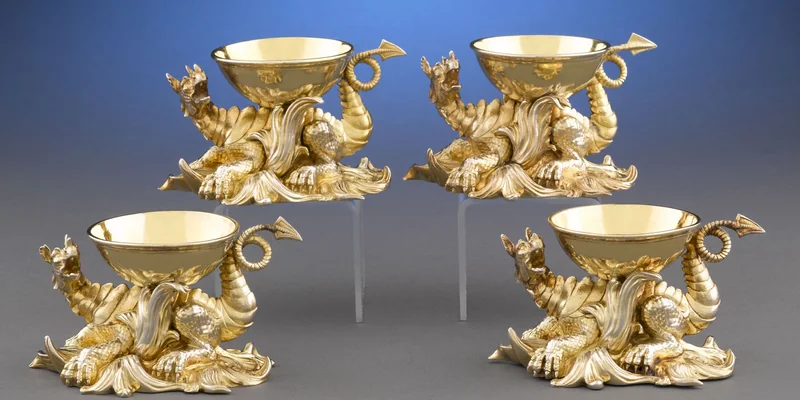
Cast-footed Victorian salts (c.1830–1900) — heavier, more ornate. Not pierced. Round or oval solid bodies on three or four cast feet (paw, hoof, or scroll). Gilt interiors were standard by mid-Victorian to protect the silver from salt’s corrosive effect. Ornament ranges from restrained beading and reeding early in the era to elaborate rococo revival by the 1860s.
How to date silver salt cellars from the marks
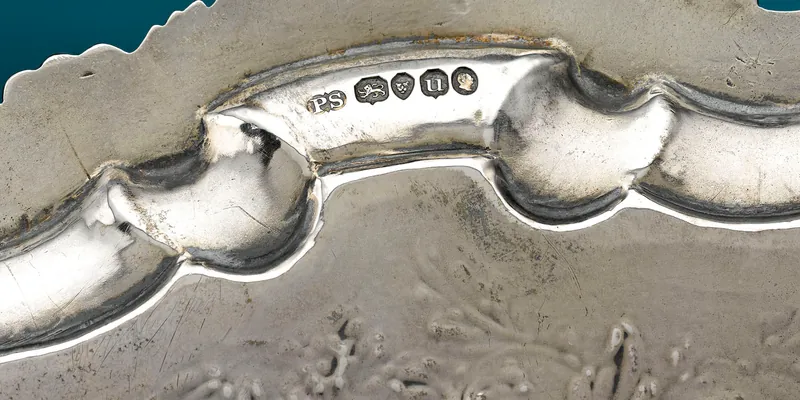
Every genuine British silver salt carries a full hallmark cluster on the base: maker’s initials, lion passant (or seated Britannia for the 1697–1720 higher standard), assay-office town mark, and date letter. The town mark tells you which office assayed the piece (leopard’s head for London, anchor for Birmingham, crown or White Rose for Sheffield, castle for Edinburgh), and the date letter pins the year within a decade once you look it up against that office’s cycle chart.
Two era-specific single-mark clues short-cut the dating:
- Sovereign’s head duty mark — the piece was assayed between 1784 and 1890. King’s head = 1784–1837 (George III, IV, or William IV); Queen’s head = 1837–1890 (Victoria).
- Seated Britannia + numeral 958 — either the 1697–1720 mandatory Britannia standard period, or the optional 958 standard used voluntarily since.
For the full framework on dating British silver from the marks, see our guide to dating antique silver by era, and for the full hallmark decode see how to read British silver hallmarks.
Where to find the hallmarks on a silver salt cellar
Salt cellars are small and the marks are often struck in awkward positions to fit the shape:
- Trencher salts — base center or underside of the rim, in a single row
- Pierced Georgian salts — underside of the base plate (unscrew or lift the glass liner first). Sometimes on the side of one foot.
- Cast-footed Victorian salts — base of one foot or underside of the body. On rectangular salts, look inside the foot rim on the base.
Salts with the marks worn beyond reading can often still be identified by weight, style and construction period. If your salt lacks any legible marks and the base metal shows dull grey where the "silver" has worn thin, you have silver plate rather than solid silver — the story is different and much lower value. Our EPNS, EP, A1 and EPBM plate marks guide covers plated salts specifically.
Small marks on a small piece can be tough to read. Our silver hallmark identifier works from a smartphone macro shot — it reads maker, office, year, and standard even on worn Georgian salt marks. Free with signup.
Read my salt’s marks →Antique silver salt cellars value: 2026 UK auction ranges
Value on silver salts is driven by era, maker, condition of the piercing, and whether they sell as a matched pair or singly. A pair is worth 2.5–3× the price of a single salt of the same type — matched sets are hard to preserve. Rough 2026 auction ranges:
- Single Victorian cast-footed salt, unnamed maker, good condition — £40–£120
- Matched pair Victorian salts, unnamed maker, with original gilt interior — £150–£400
- Set of four (cruet set) Victorian salts, matched pattern — £300–£700
- Georgian pierced open salt, single, with original blue glass liner — £80–£250
- Georgian pierced open salt, matched pair, original liners, clear hallmarks — £250–£800
- Georgian pair by Hester Bateman, Paul Storr, or Andrew Fogelberg — £800–£3,500+
- Queen Anne trencher salts, Britannia standard, in matched pairs — £400–£1,500+
The floor on a British silver salt is roughly £20–£30 in silver melt value (they weigh 30–80g apiece and are 92.5% silver); everything above that is form, maker, era and condition. Our full antique silver valuation guide covers the framework for pricing any piece.
The blue glass liners: worth checking
Pierced Georgian salts were designed with removable cobalt blue glass liners — the glass holds the salt and stops it falling through the piercing, and its colour shows off through the silver piercing decoratively. Original glass liners more than double the value of a pierced salt. Replacements (which are often modern reproduction blue glass) are usable but hurt the price at auction — look at the base of the liner for wear patterns matching the age of the salt.
Missing liners are a common condition issue. Modern reproduction liners in the correct cobalt blue are available from specialist silver dealers, but you should disclose them on any resale.
Frequently Asked Questions
How much are antique silver salt cellars worth?
Antique silver salt cellars typically sell for £40–£200 individually and £150–£800 as matched pairs at UK auction. Georgian pierced open salts by named makers (Hester Bateman, Paul Storr, Andrew Fogelberg) reach four figures — £800–£3,500+ for matched pairs with original blue glass liners. Queen Anne trencher salts at the Britannia standard reach £400–£1,500+ per matched pair. The silver-melt floor on a single salt is £20–£30; everything above that is form, maker, and era.
What are the three types of antique silver salt cellars?
The three main forms are trencher salts (c.1690–1740, small solid geometric pieces with a shallow well cut into the top), pierced Georgian open salts (c.1760–1810, vase- or boat-shaped pierced silver bodies on cast feet with cobalt blue glass liners), and cast-footed Victorian salts (c.1830–1900, heavier ornate solid bodies on cast paw, hoof, or scroll feet, usually with gilt interiors to resist salt corrosion).
Where are the hallmarks on a silver salt cellar?
On trencher salts, hallmarks are typically struck on the base center or the underside of the rim in a single row. On pierced Georgian salts, the marks are on the underside of the base plate — you may need to unscrew or lift out the glass liner first — or occasionally on the side of one foot. On cast-footed Victorian salts, look on the base of one foot or the underside of the body; on rectangular salts, inside the foot rim on the base.
Why do silver salt cellars have blue glass liners?
Pierced Georgian salt cellars were designed with cobalt blue glass liners for two reasons: the glass holds the salt so it doesn't fall through the piercing, and the blue colour shows off decoratively through the silver piercing. Original glass liners more than double the value of a pierced salt at auction. Modern reproduction liners are available in the correct cobalt blue but should be disclosed on any resale.
Why are silver salt cellars gilded inside?
Salt is chemically corrosive to silver — it accelerates tarnishing and can pit the metal over time. Victorian silversmiths standardised on gilding the interior of cast-footed salt cellars (applying a thin gold layer inside the well) to protect the silver from direct contact with salt. Original gilding that has worn thin is common and neutral to value; complete regilding by a modern jeweller is acceptable but should be disclosed.
Conclusion
Antique silver salt cellars are the collectible entry point to English silver — small enough to display in numbers, cheap enough that a genuine 18th-century pair is often under £500, and marked to the same assay standards as the great teapots and salvers of the era. Read the marks first (they’re on the base), identify the form (trencher, pierced Georgian, or cast-footed Victorian), verify the condition of the piercing and the presence of the original glass liner, and value falls out cleanly.
For a specific estimate on your salts with comparable recent auction results, upload a photo of the base marks to our free AI silver appraisal.
925s.ai provides AI-assisted appraisals for informational purposes. For certified valuations, consult an accredited appraiser.
Continue Reading